Bluedose


Quick answer
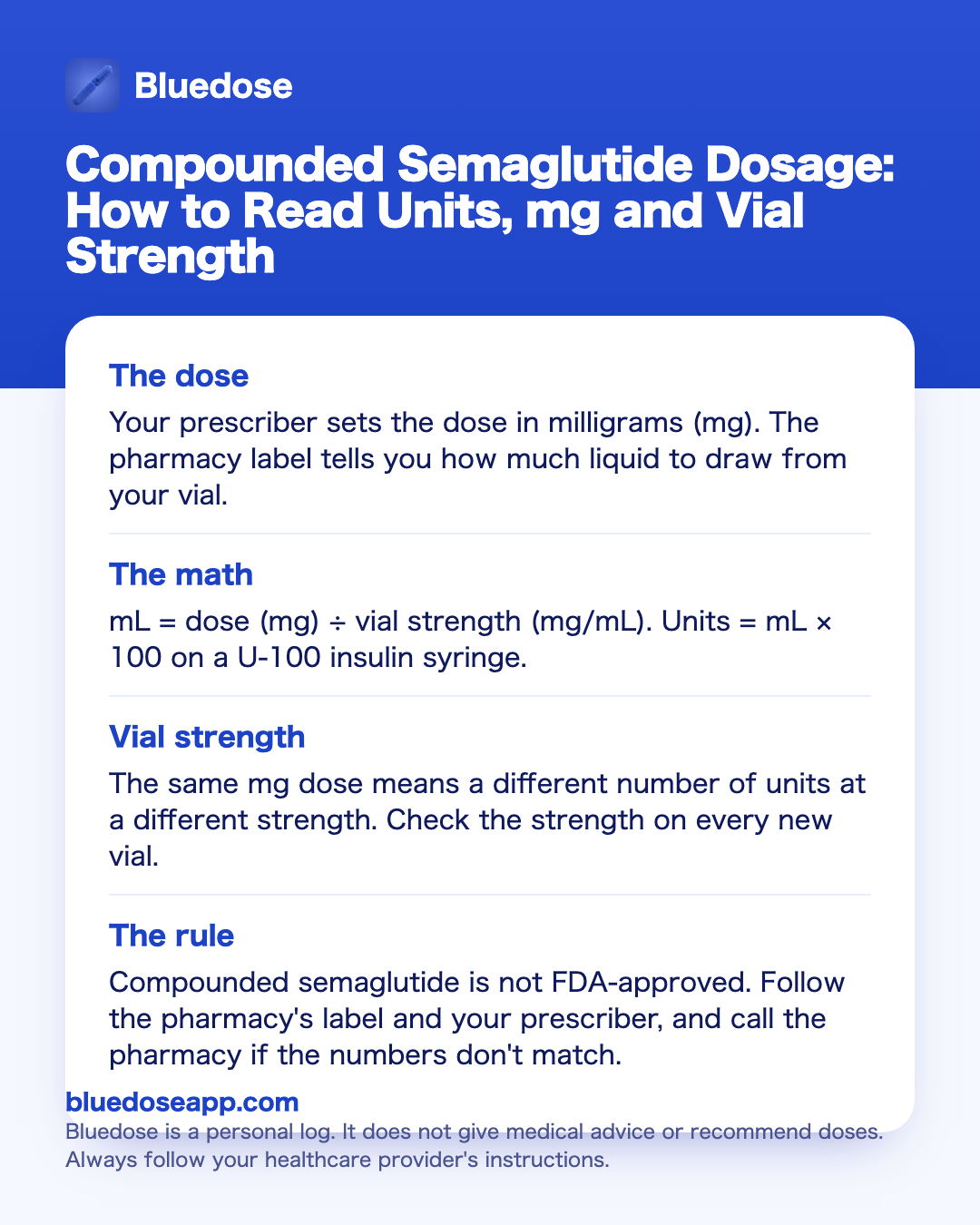
- The doseYour prescriber sets the dose in milligrams (mg). The pharmacy label tells you how much liquid to draw from your vial.
- The mathmL = dose (mg) ÷ vial strength (mg/mL). Units = mL × 100 on a U-100 insulin syringe.
- Vial strengthThe same mg dose means a different number of units at a different strength. Check the strength on every new vial.
- The ruleCompounded semaglutide is not FDA-approved. Follow the pharmacy's label and your prescriber, and call the pharmacy if the numbers don't match.

Best overall: Bluedose
Bluedose works with compounded semaglutide and logs each shot in a tap: the drug, the dose you type from your prescriber, and the time. A body map records the injection site and suggests the next one, and a reminder arrives at the time you choose. It does not calculate doses, so your pharmacy label stays the source of truth.
Free on the App StoreHow compounded semaglutide dosage works
Brand semaglutide comes in pens. Ozempic and Wegovy pens deliver a set dose in milligrams, so you never see a unit number. Compounded semaglutide usually comes in a vial, and you draw it up with a syringe. That one change causes most of the confusion.
There are three numbers to keep apart:
- The dose in mg. This is the amount of semaglutide your prescriber orders, for example 0.25 mg. It is the number that matters to your body.
- The vial strength in mg/mL. This tells you how much semaglutide is in each milliliter of liquid. It is printed on the vial and the pharmacy label. Vials come at different strengths.
- The units on the syringe. Insulin syringes are marked in units. On a U-100 syringe, 100 units equal 1 mL. Units measure liquid, not drug.
So a unit number means little on its own. Ten units from one vial will hold a different amount of semaglutide than ten units from a vial of another strength. The mg dose is the instruction. The units are how you measure it with the vial you have.
This is why your pharmacy label matters more than anything you read online. A clear label states the dose in mg, the vial strength, and often the volume or units to draw. When those agree, you have a clear instruction. When they don't, or one is missing, call the pharmacy before you inject.
Compounded drugs are not FDA-approved. A pharmacy prepares them, and each pharmacy sets its own strengths and directions. Always follow the pharmacy's label and your prescriber. If you are new to vials, our guide to your first compounded semaglutide vial walks through the setup.
Semaglutide units to mg: the math, step by step
The conversion uses two short formulas. Both assume a U-100 insulin syringe, where 100 units equal 1 mL.
- mL = dose (mg) ÷ strength (mg/mL)
- units = mL × 100
Here is the math with illustrative numbers. These are not a dose recommendation.
- Dose 0.5 mg, vial strength 2.5 mg/mL: 0.5 ÷ 2.5 = 0.2 mL. Then 0.2 × 100 = 20 units.
- Same 0.5 mg dose, vial strength 5 mg/mL: 0.5 ÷ 5 = 0.1 mL. Then 0.1 × 100 = 10 units.
The dose did not change. The vial did, so the units halved.
To go the other way, from units back to mg, use mg = (units ÷ 100) × strength. For example, 20 units from a 2.5 mg/mL vial is 0.2 mL, and 0.2 × 2.5 = 0.5 mg. This reverse check is useful when your label lists units and you want to confirm they match the mg dose your prescriber ordered.
A few habits will keep the math safe:
- Write the strength next to every dose. A dose without a strength cannot be turned into units.
- Watch the decimal point. 0.25 and 2.5 look alike on a small label, and they differ tenfold.
- Redo the math when anything changes: a new vial, a new strength, or a new dose from your prescriber.
Our semaglutide dosage calculator does this math from the numbers you enter. It does not choose a dose for you. If the calculator and your label disagree, the label and your pharmacist win. Tirzepatide vials use the same formulas, covered in our tirzepatide dosage guide.
Why vial strength changes the number of units
Vial strength is the number most people forget to check. It decides how many units carry your dose.
Think of it like juice concentrate. A stronger concentrate needs less liquid to deliver the same amount of flavor. A stronger vial needs fewer units to deliver the same mg of semaglutide. A weaker vial needs more.
This matters in real life for a few reasons:
- Refills may arrive at a different strength. Pharmacies set their own strengths. A new vial may not match the last one.
- Your prescriber may change the dose. A new mg dose means new units, even from the same vial.
- Labels vary in layout. Some lead with units, some with mg, some with mL. Read all three every time.
Stop and call the pharmacy if:
- the units on the label don't match your own math,
- the strength printed on the vial differs from the strength on the label,
- the number of units looks very different from last time and nobody told you why, or
- you are not sure which syringe the directions assume.
A quick call takes a few minutes. Drawing the wrong amount is the mistake this whole page is meant to prevent. The comparison table below shows how much the units shift between two example strengths for the same mg doses.
How compounded doses compare with the Ozempic and Wegovy labels
Ozempic and Wegovy are the FDA-approved semaglutide brands. Their prescribing information describes fixed weekly steps. These steps are a useful reference, but they are not your compounded directions.
Ozempic (type 2 diabetes), once weekly:
- 0.25 mg for 4 weeks (a starting dose)
- then 0.5 mg
- may increase to 1 mg after at least 4 weeks
- then to 2 mg after at least 4 weeks, the maximum
Wegovy (weight), once weekly:
- weeks 1-4: 0.25 mg
- weeks 5-8: 0.5 mg
- weeks 9-12: 1 mg
- weeks 13-16: 1.7 mg
- from week 17: 2.4 mg (1.7 mg is allowed as maintenance if 2.4 mg isn't tolerated)
A higher 7.2 mg option exists in some countries; ask your prescriber. See the full ozempic dosage chart and wegovy dosage chart for detail.
A prescriber who orders compounded semaglutide may follow a similar ladder or set a different one. Either way, the dose and the timing of any increase come from your prescriber, not from a brand chart. Don't move up, down, or skip on your own.
The labels note that the most common side effects, such as nausea, diarrhea, vomiting and constipation, are usually most common when starting or after a dose increase. That is a good reason to log how you feel in the days after any change, so you have clear notes for your next appointment.
Missed doses, injection sites and storage with vials
Vials change how you measure, not how the drug behaves. The brand labels still give helpful context, but your pharmacy's directions come first.
Missed doses. The brand rules differ:
- Ozempic: take it as soon as possible within 5 days of the missed dose. If more than 5 days have passed, skip it and take the next dose on the regular day.
- Wegovy: if the next dose is more than 2 days (48 hours) away, take the missed dose as soon as possible. If it is less than 2 days away, skip it. If more than 2 weeks of doses are missed, the prescriber may restart the dose schedule.
For compounded semaglutide, ask your prescriber which rule applies. Our guide to a missed dose ozempic explains the brand rule in more detail. Semaglutide has an elimination half-life of about 1 week and takes about 5 weeks to clear, so one missed shot does not mean it is all gone.
Injection sites. The labels describe injecting under the skin of:
- the stomach area, at least 2 inches (5 cm) from the belly button
- the front of the thigh
- the back of the upper arm, often with help
Rotate the site with each dose. You can stay in the same area but use a different spot. Our page on injection site rotation shows a simple pattern.
Storage. Brand pens go in the refrigerator at 2-8 °C (36-46 °F) before first use, away from light, and must not be frozen. Storage for a compounded vial is set by the pharmacy that made it, so follow its label and ask your pharmacist if anything is unclear.
What to write down for every compounded shot
With pens, the dose is built in. With vials, you do the measuring, so a good record matters more.
For each shot, note:
- Date and time
- Dose in mg, as your prescriber ordered
- Vial strength in mg/mL
- Units drawn
- Injection site
- How you felt in the following days, including any side effects
This record does three jobs. It catches a strength change before it becomes a mistake. It gives your prescriber a clear history when you discuss the next step. And it shows patterns in common GLP-1 side effects such as nausea after a dose change.
A paper sheet will hold all of this. An app adds reminders, site rotation and trends. Bluedose works as a GLP-1 tracker for compounded semaglutide: you log the drug, the dose you type, and the time in a tap, then tap the body map for the site. Check-ins record food noise and side effects with notes. Keep your pharmacy label with your vial, since Bluedose does not calculate or check units.
Semaglutide units to mg: example conversions
These rows apply the formula (mL = mg ÷ mg/mL, units = mL × 100) to the mg steps on the brand labels at two example strengths. They show how strength changes units. Your vial may have another strength, and your dose comes from your prescriber and pharmacy label.
| Dose (mg) | Where it appears on brand labels | Example vial A: 2.5 mg/mL | Example vial B: 5 mg/mL |
|---|---|---|---|
| 0.25 | Ozempic and Wegovy starting dose | 0.1 mL = 10 units | 0.05 mL = 5 units |
| 0.5 | Ozempic after 4 weeks; Wegovy weeks 5-8 | 0.2 mL = 20 units | 0.1 mL = 10 units |
| 1 | Ozempic step; Wegovy weeks 9-12 | 0.4 mL = 40 units | 0.2 mL = 20 units |
| 1.7 | Wegovy weeks 13-16 | 0.68 mL = 68 units | 0.34 mL = 34 units |
| 2 | Ozempic maximum | 0.8 mL = 80 units | 0.4 mL = 40 units |
| 2.4 | Wegovy from week 17 | 0.96 mL = 96 units | 0.48 mL = 48 units |
When a paper log or phone note is enough
For many people, a simple log is enough. If you take one shot a week from the same vial, a sheet on the fridge with columns for date, mg, strength, units and site will cover the essentials. A note on your phone works the same way, and a weekly calendar alert will remind you of shot day.
A paper log has real strengths. It sits next to your vial, so you see the strength every time you write. It needs no setup and no battery. You can hand it to your prescriber at a visit.
The limits show up over time. Paper won't remind you. A calendar alert doesn't know whether you took the shot. Notes don't suggest the next injection site, and spotting a pattern in side effects across months of handwriting is slow. If those gaps don't bother you, stay with what works.
When you need more than a note
- You forget shot day or can't remember whether you already injected this week.
- You lose track of which spot you used last and want a site suggestion each time.
- Your prescriber is changing your dose and you want a clear record of how you felt after each change.
- You want to see weight, protein and food noise over months, not scattered across notes.
- You want a private record with no account, kept on your iPhone and your own iCloud.
How to start tracking compounded semaglutide with Bluedose
Install Bluedose
Download Bluedose: GLP-1 Tracker for iPhone (iOS 18 or later). It is free on the App Store and needs no account, which makes it a private GLP-1 tracker.
Add compounded semaglutide and your schedule
Choose compounded semaglutide and set the schedule your prescriber gave: weekly, twice weekly, daily or custom. Type the dose exactly as your prescriber ordered it.
Set your reminder
Pick the reminder time. On shot day, a Lock Screen card shows a Log Shot button.
Log each shot and tap the site
After you inject, log the shot in a tap and tap the body map where you injected. Bluedose remembers your rotation and suggests the next site.
Add check-ins
Record food noise and side effects with notes in the days after each shot, especially after a dose change, so you have a clear history for your prescriber.
FAQ
How many units is 0.25 mg of compounded semaglutide?
It depends on your vial's strength. The math is mL = dose (mg) ÷ strength (mg/mL), then units = mL × 100 on a U-100 syringe. From a vial labeled 2.5 mg/mL, 0.25 mg is 0.1 mL, or 10 units. From a 5 mg/mL vial, the same 0.25 mg is 0.05 mL, or 5 units. These are illustrations of the math. Your pharmacy label and your prescriber decide your dose.
How do I convert semaglutide units to mg?
Reverse the formula: mg = (units ÷ 100) × strength in mg/mL. For example, 20 units from a 2.5 mg/mL vial is 0.2 mL, and 0.2 × 2.5 = 0.5 mg. This is a good way to check that the units on your pharmacy label match the mg dose your prescriber ordered. If they don't match, call the pharmacy before you inject.
Is compounded semaglutide dosed the same way as Ozempic or Wegovy?
It is the same active ingredient, but compounded products are not FDA-approved and each pharmacy sets its own strengths and directions. The Ozempic and Wegovy labels describe fixed weekly steps that start at 0.25 mg. Your prescriber may use a similar ladder or a different one. Follow your prescriber and the pharmacy's label, not a brand chart.
My new vial has a different strength. What changes?
The mg dose your prescriber ordered may stay the same, but the units you draw will change. A stronger vial means fewer units for the same dose. Read the new label, redo the math, and ask your pharmacist to confirm the units before your first shot from the new vial.
What should I do if I miss a compounded semaglutide dose?
The brand labels give different rules. Ozempic says to take a missed dose within 5 days, otherwise skip it and take the next dose on the regular day. Wegovy says to take it if the next dose is more than 2 days away, otherwise skip it. For a compounded product, follow the pharmacy's directions and ask your prescriber what applies to you.
Can Bluedose calculate my compounded semaglutide dose?
No. Bluedose is a personal log. It does not recommend or calculate doses. You type the dose your prescriber gave, and Bluedose records it with the time and injection site. The semaglutide dosage calculator on our site does the units math from numbers you enter, and your pharmacy label always comes first.
Where do I inject compounded semaglutide?
The semaglutide labels describe injecting under the skin of the stomach area (at least 2 inches or 5 cm from the belly button), the front of the thigh, or the back of the upper arm. They say to rotate the injection site with each dose. You can use the same body area but pick a different spot each time.
Bottom line
Compounded semaglutide dosage comes down to three numbers: the mg dose your prescriber orders, the strength of your vial, and the units you draw. The math is simple, mL = mg ÷ strength and units = mL × 100, but the strength changes the answer, so check it on every vial. When your own math and the label disagree, call the pharmacy. Follow the pharmacy's label and your prescriber, never a chart from the internet.
A paper log will serve many people well. If you want reminders, site rotation and a private history of doses and side effects in one place, Bluedose is a calm way to keep that record. This is general information, not medical advice.
Sources
- Ozempic prescribing information
- Wegovy prescribing information
- Wegovy dosing (Novo Nordisk, for pharmacists)
- Mayo Clinic, semaglutide proper use
Save this guide
Keep the key points as an image on your phone.
Log every vial shot in one place
Start for free: Bluedose logs each compounded semaglutide shot, site and check-in privately on your iPhone.
Free on the App Store