Bluedose


Quick answer
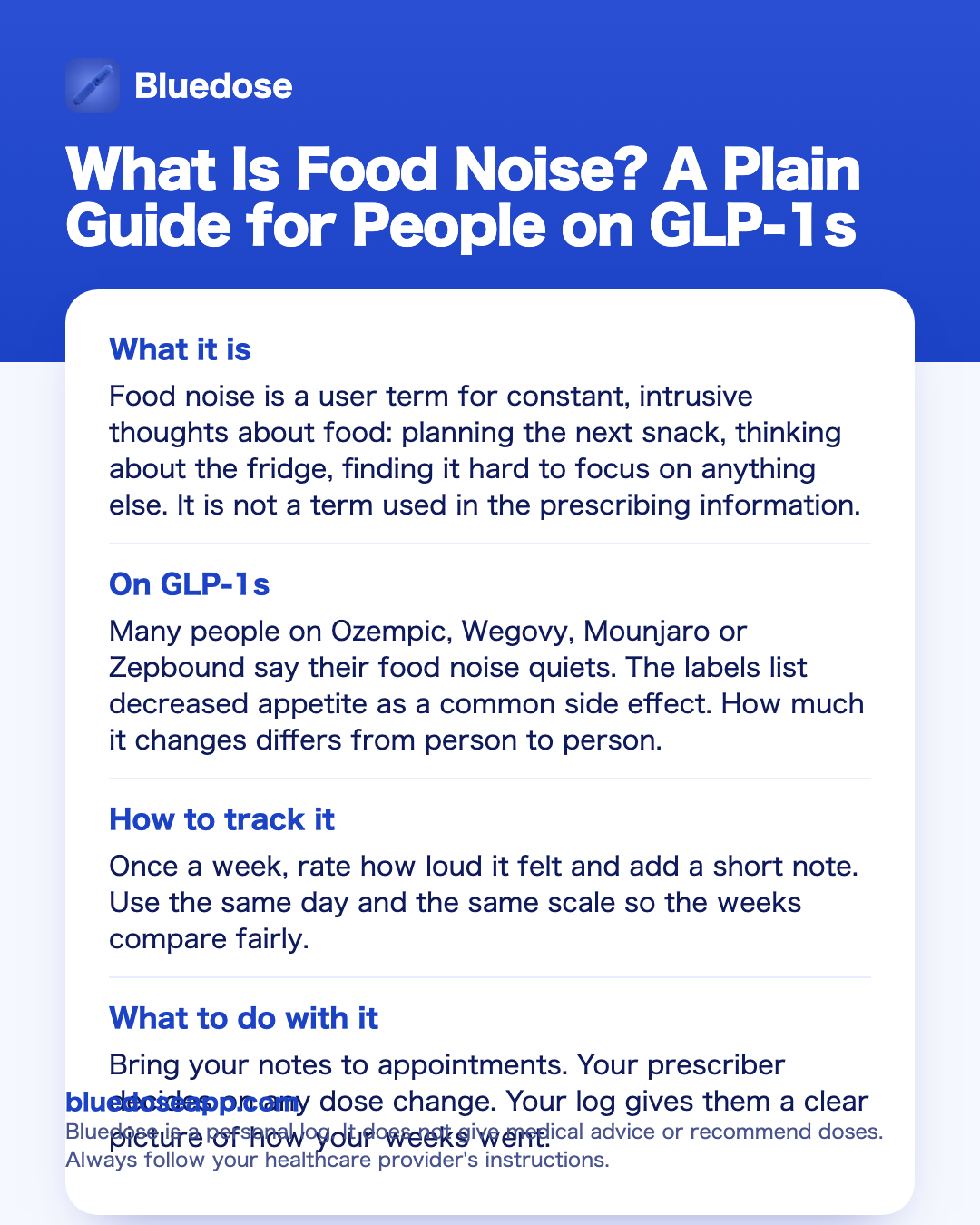
- What it isFood noise is a user term for constant, intrusive thoughts about food: planning the next snack, thinking about the fridge, finding it hard to focus on anything else. It is not a term used in the prescribing information.
- On GLP-1sMany people on Ozempic, Wegovy, Mounjaro or Zepbound say their food noise quiets. The labels list decreased appetite as a common side effect. How much it changes differs from person to person.
- How to track itOnce a week, rate how loud it felt and add a short note. Use the same day and the same scale so the weeks compare fairly.
- What to do with itBring your notes to appointments. Your prescriber decides on any dose change. Your log gives them a clear picture of how your weeks went.

Best overall: Bluedose
Bluedose has a food noise check-in with notes built in, right next to your shot log and side effect check-ins. Trends show food noise over time alongside weight and protein, so you see change across weeks instead of guessing. It is Free on the App Store, needs no account, and keeps your data on your iPhone and in your private iCloud.
Free on the App StoreWhat is food noise?
Food noise is a name people use for constant, intrusive thoughts about food. It is the background chatter that keeps pulling your attention back to eating, even when you are not hungry and even when you would rather think about something else.
People describe it in different ways:
- Planning the next meal while still eating this one.
- Thinking about a snack in the kitchen while you work, read or try to sleep.
- Feeling that a food you saw earlier is still "calling" you hours later.
- Bargaining with yourself about what you will or will not eat today.
- Feeling tired from how much space food takes up in your head.
The term comes from people living with it, not from medicine. You will not find "food noise" in the prescribing information for Ozempic, Wegovy, Mounjaro or Zepbound. That matters, because it means there is no official scale for it. The best measure of your food noise is your own record of it.
Food noise is not the same as hunger. Hunger is a body signal. It builds over hours, it eases after a meal, and almost any food will settle it. Food noise is more like a thought that keeps coming back. It shows up right after you have eaten, it fixes on specific foods, and a meal does not switch it off. Keeping the two apart in your notes will make your log much clearer. A hungry day with quiet thoughts is a very different day from a full stomach with loud ones.
Food noise on GLP-1 medicines
Many people taking a GLP-1 medicine, such as Ozempic or Wegovy (semaglutide) or Mounjaro or Zepbound (tirzepatide), say their food noise gets quieter. For some it is a big change. For others it is small. There is no way to know in advance which applies to you.
Here is what the labels do and do not say:
- The prescribing information lists decreased appetite among the most common side effects, along with nausea, diarrhea, vomiting, constipation, stomach pain and indigestion.
- These side effects are usually most common when starting or after a dose increase.
- The labels do not measure or mention food noise. Any claim about how much it will change, or how fast, comes from personal reports, not from the label.
So there is no promised timeline. Your experience will be your own, and it may change as your body adjusts and as your prescriber moves you through the dose schedule. For the full list of what the labels describe, see our guide to GLP-1 side effects. If you are about to move up a step, our page on a Mounjaro dose increase shows what the label schedule looks like.
One point is easy to miss. When appetite drops, it is tempting to treat quiet food noise as the whole goal. It is one signal among several. Nausea, eating too little and low protein are worth noticing too, and they belong in the same log.
Why track food noise every week
Food noise is easy to feel and hard to remember. On a quiet week, it is hard to recall how loud it used to be. On a loud week, it feels as if nothing has changed. A short weekly entry fixes both problems.
A weekly record helps you:
- See real change. Comparing week 2 with week 10 on the same scale beats comparing a vague memory with today.
- Connect it to your shots. When your rating sits next to your shot day and dose, you see whether it shifted after a dose step or during a late week.
- Separate it from side effects. A quiet head on a nauseous week means something different from a quiet head on a good week.
- Prepare for appointments. Your prescriber decides on dose changes. Clear notes give them more than "I think it's better." A simple GLP-1 side effects log for your doctor is easy to build from the same entries.
- Stay honest with yourself. Written notes take the guesswork out of how you are doing.
Why weekly and not daily? Ozempic, Wegovy, Mounjaro and Zepbound are all once-weekly shots on the label schedule, so a weekly check-in lines up with the rhythm of treatment. It is also light enough to keep doing for months. If a week is hard, add extra notes on those days. A food noise tracker that sits next to your shot history makes this habit simple.
How to rate food noise and write useful notes
You do not need a clinical tool. You need the same simple scale, used the same way, every week.
Pick a scale and keep it. A 0 to 10 score works well: 0 means you barely thought about food beyond meals, 10 means it filled most of your day. If numbers feel forced, use three words: quiet, some, loud. The scale matters less than using the same one every time.
Pick a check-in day. Choose one day and stick with it. Your shot day is an easy anchor, because you are already opening your log.
Rate the whole week, not the moment. Ask yourself: across the last seven days, how loud was it?
Then add a short note. Two or three lines are enough. Useful prompts:
- When was it loudest: morning, afternoon or late evening?
- Did anything set it off, such as stress, poor sleep, a long gap between meals or a social event?
- Which foods did it fix on?
- Was it hunger, food noise, or both?
- Any side effects this week, such as nausea or constipation?
- Was this a normal shot week, a late shot, or a new dose?
An example note: "Food noise 3/10. Loudest after work on Tuesday and Wednesday. Slept badly both nights. Mild nausea the day after my shot. More protein at lunch this week."
That note takes under a minute to write. In two months, it will be far more useful than any memory.
Food noise, protein and side effects in one place
Food noise rarely changes alone. When it quiets, eating patterns change too, and that is where the other parts of your log come in.
- Protein. With less appetite, some meals shrink. A daily count in a protein tracker shows whether quieter food noise also means less protein. Our guide to protein on GLP-1 explains why people pay attention to this. Ask your prescriber or a dietitian what target fits you.
- Side effects. Nausea and stomach upset will lower interest in food on their own. Logging them with a side effect tracker helps you tell "my food noise is quieter" apart from "I feel too sick to want food."
- Weight. Weight changes slowly and moves around from day to day. Seeing it on the same timeline as food noise, in a GLP-1 weight loss tracker, gives context to both.
None of these numbers tells you what to do next on its own. Together, they give you and your prescriber a fuller picture of how treatment is going.
What a food noise log can and cannot tell you
A log is a record, not a diagnosis. It will show you patterns. It will not tell you why they happen or what to change.
What it can do:
- Show whether your food noise is changing over weeks.
- Show how it lines up with shot days, dose steps and side effects.
- Give you specific examples to share at appointments.
- Help you notice when something feels off.
What it cannot do:
- Decide your dose. If food noise feels louder, do not change, add or skip a dose on your own. Follow your prescriber.
- Replace medical care. If thoughts about food feel distressing or out of control, talk to your doctor. That is worth raising whether or not you take a GLP-1.
- Catch serious problems. Severe stomach pain that may reach your back, signs of a serious allergic reaction, or other worrying symptoms need medical help, not a note.
Think about privacy too. Food noise notes are personal. Before you pick a tool, check where your notes are stored and who can see them. A private GLP-1 tracker keeps them on your own device. If you like asking questions in plain language, a GLP-1 journal lets you ask about your own entries, such as whether your food noise is changing.
Ways to keep a food noise log, compared
Four ways to keep a weekly food noise log, side by side. All of them work. They differ in how much you have to set up and keep together yourself.
| What you need | Phone notes | Paper log | Spreadsheet | Bluedose |
|---|---|---|---|---|
| Cost to start | Free, already on your phone | A notebook and pen | Free if you have a spreadsheet app | Free on the App Store |
| Weekly food noise entry | Typed by hand | Written by hand | One row per week | Built-in food noise check-in |
| Notes with each entry | Yes | Yes | Yes, in a cell | Yes, with each check-in |
| Shot day and dose in the same place | Only if you type them | Only if you write them | Only if you add columns | Every shot logged with drug, dose and time |
| Side effects alongside | Manual | Manual | Manual | Side effect check-ins with notes |
| See change over time | Scroll and reread | Flip back through pages | Yes, if you build a chart | Trends for food noise, weight and protein |
| Shot reminder | Separate alarm or calendar | None | None | Reminder plus a Lock Screen card on shot day |
| Ask questions about your entries | No | No | Formulas only | Ask, powered by Apple Intelligence on supported iPhones |
| Privacy | Depends on how your notes sync | Stays with you | Depends on where the file is stored | No account, no ads, no tracking; data on your iPhone and private iCloud |
| Works on | Any phone | Anywhere | Phone or computer | iPhone only (iOS 18+) |
When phone notes or a paper log is enough
For many people, a free notes app or a notebook is enough. If you want to jot down one food noise score and a line or two each week, you do not need a dedicated app.
A simple option works well when:
- You are on a stable dose and only want a light weekly check-in.
- You already track your shots somewhere you trust, such as a calendar.
- You prefer writing by hand and like rereading your pages.
- You only need a few weeks of notes before an appointment.
To make a basic log work, use the same scale, write on the same day, and put the date, your dose and the score at the top of each entry. A calendar reminder on shot day will prompt you.
The limits show up over time. Notes pile up, comparing week 3 with week 20 means scrolling, and food noise, shots, side effects and protein end up in different places. That is fine for a while. It gets harder after a few months or around a dose change.
When you need more than a notes app
- You want food noise, shots, side effects and protein in one timeline instead of four places.
- You want to see food noise as a trend over months without building a chart yourself.
- You are moving through dose steps and want each week's notes tied to the dose you logged.
- You want a shot reminder and a Log Shot button on the Lock Screen, so the weekly check-in becomes part of shot day.
- You want to ask plain questions about your own entries, such as "Is my food noise changing?"
How to start tracking food noise with Bluedose
Install Bluedose
Download Bluedose: GLP-1 Tracker. It is Free on the App Store for iPhone with iOS 18 or later. There is no account to create, no ads and no tracking.
Add your medicine and schedule
Choose your medicine: Zepbound, Mounjaro, Wegovy, Ozempic, or compounded semaglutide or tirzepatide. Type the dose your prescriber gave you, then pick a weekly, twice weekly, daily or custom schedule and a reminder time.
Log your shot on shot day
On shot day, a Lock Screen card with a Log Shot button appears. Tap it, then tap the spot on the body map where you injected. Bluedose remembers your rotation and suggests the next site.
Do your weekly food noise check-in
On the same day each week, open the food noise check-in, record how loud it felt and add a short note. If you had side effects, log them in the side effect check-in with their own notes.
Review trends and ask
After a few weeks, open Trends to see food noise, weight and protein over time. On supported iPhones, use Ask to type questions like "Is my food noise changing?" and bring what you find to your next appointment.
FAQ
What is food noise?
Food noise is a common name for constant, intrusive thoughts about food. It is the chatter that pulls your attention back to eating even when you are not hungry. People use the term to describe their own experience. It is not a clinical diagnosis.
Is food noise a medical term?
No. It is a user term. The prescribing information for Ozempic, Wegovy, Mounjaro and Zepbound does not use it. The labels do list decreased appetite as a common side effect, which is the closest label language.
Does food noise go away on GLP-1 medicines?
Many people on GLP-1 medicines report that their food noise quiets. How much it changes, and when, differs from person to person, and the labels make no promise about it. A weekly log will show what is happening for you.
Is food noise the same as hunger?
No. Hunger is a body signal that builds over hours and eases after a meal. Food noise is a thought about food that keeps returning, even when you are full. Note them separately in your log so you can tell them apart over time.
How often should I track food noise?
A weekly check-in is a good rhythm. It lines up with once-weekly shots such as Ozempic, Wegovy, Mounjaro and Zepbound, and it is light enough to keep up for months. Use the same day and the same scale each week, and add extra notes on unusual days if you want more detail.
What if my food noise gets louder before my next shot?
Write it down, including which days it was loudest and anything else going on that week. Do not change your dose, take an extra dose or move your shot day on your own. Bring the pattern to your prescriber, who will decide whether anything should change.
Can Bluedose tell me if I need a higher dose?
No. Bluedose is a personal log. It does not give medical advice and does not recommend or calculate doses. It shows your food noise, shots, side effects and other entries over time so you can talk them through with your prescriber.
Bottom line
Food noise is the constant pull of thoughts about food. It is a user term, not a label term, and many people on GLP-1 medicines say it quiets. Because the labels do not measure it, your own weekly notes are the clearest record you will have.
If a notebook or notes app keeps you consistent, use it. For many people that is enough. If you want food noise next to your shots, side effects, protein and weight, with trends you do not have to build, Bluedose does that and keeps your data private on your iPhone. Either way, use your log to talk with your prescriber, and let them guide any dose decision. This is general information, not medical advice.
Sources
- Ozempic prescribing information
- Wegovy prescribing information
- Mounjaro prescribing information
- Zepbound prescribing information
Save this guide
Keep the key points as an image on your phone.
Track your food noise each week
Start for free with Bluedose and keep a weekly food noise check-in, with notes, next to every shot you log.
Free on the App Store