Bluedose


Quick answer
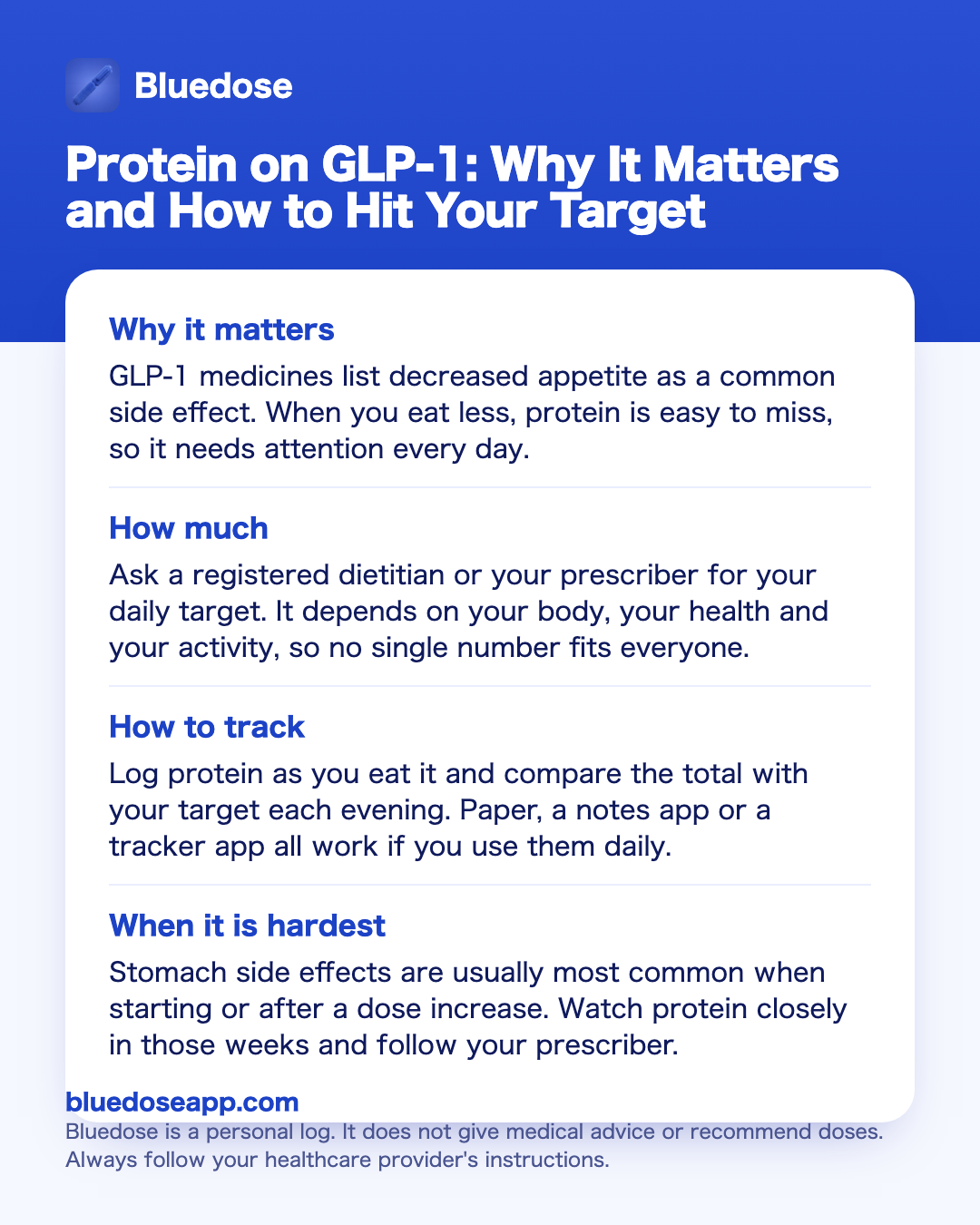
- Why it mattersGLP-1 medicines list decreased appetite as a common side effect. When you eat less, protein is easy to miss, so it needs attention every day.
- How muchAsk a registered dietitian or your prescriber for your daily target. It depends on your body, your health and your activity, so no single number fits everyone.
- How to trackLog protein as you eat it and compare the total with your target each evening. Paper, a notes app or a tracker app all work if you use them daily.
- When it is hardestStomach side effects are usually most common when starting or after a dose increase. Watch protein closely in those weeks and follow your prescriber.

Best overall: Bluedose
Bluedose lets you add protein with one tap and watch your daily goal fill up, right next to your shot log, food noise check-ins and weight trend. You will see whether protein dips on the days after a shot or a dose increase. It is private, with no account, and it does not count calories or tell you what to eat.
Free on the App StoreWhy protein on GLP-1 medicines needs attention
GLP-1 medicines change how much you want to eat. The prescribing information for Ozempic, Wegovy, Mounjaro and Zepbound lists decreased appetite among the most common side effects, together with nausea, diarrhea, vomiting, constipation, stomach pain and indigestion. Many users also report that their food noise, the constant thoughts about food, gets quieter.
For many people that is the point of the medicine. It also means every meal counts more. When the plate gets smaller, protein is often the first thing to slip. A few crackers on a queasy afternoon fill you up, but they add little protein.
Protein is the nutrient your body uses to build and repair muscle and other tissue. That is why many care teams ask about it at check-ins during GLP-1 treatment.
Here is what tends to change once you start:
- Smaller portions. You feel full sooner and stop earlier.
- Fewer meals. Some people skip breakfast or lunch without noticing.
- Food that suddenly feels wrong. On nausea days, rich or heavy foods may not appeal.
- Uneven days. Shot day and the day after may look very different from the rest of the week.
None of this means something is wrong. It means protein will not take care of itself. A simple daily habit closes the gap.
How much GLP-1 protein do you need? Ask your dietitian
You will find many protein numbers online. This page does not add another one, and for good reason. The right daily target depends on things a website cannot see:
- your height, weight and age
- how active you are, and whether you do strength training
- your kidney health and any other conditions
- the other medicines you take
- what you already eat in a normal week
A registered dietitian is the best person to set your target. Your prescriber can also help or refer you. If you have kidney problems, tell them before they give you a number.
Useful questions to bring:
- What daily protein target should I aim for?
- Should I count it in grams, servings or portions?
- Which protein foods fit my health and my budget?
- Are protein shakes or bars okay for me?
- What should I do on days when I cannot eat much?
Write the answers down. Once you have a number, your only job is to track against it. That part is simple, and it is where most people fall short.
Protein on Ozempic, Wegovy, Mounjaro and Zepbound: when it gets harder
Protein on Ozempic follows the same pattern as protein on Wegovy, Mounjaro or Zepbound. The prescribing information says stomach side effects are usually most common when starting the medicine or after a dose increase. Those are the weeks when eating enough feels hardest.
The label schedules show when those steps happen:
- Ozempic: 0.25 mg once weekly for 4 weeks as a starting dose, then 0.5 mg. It may go up to 1 mg after at least 4 weeks, then to 2 mg after at least 4 more weeks (maximum 2 mg).
- Wegovy: 0.25 mg in weeks 1-4, 0.5 mg in weeks 5-8, 1 mg in weeks 9-12, 1.7 mg in weeks 13-16, and 2.4 mg once weekly from week 17. A higher 7.2 mg option exists in some countries; ask your prescriber.
- Mounjaro and Zepbound: 2.5 mg once weekly for 4 weeks, then steps of 2.5 mg after at least 4 weeks on the current dose (5, 7.5, 10, 12.5 mg), up to a maximum of 15 mg once weekly.
Your prescriber decides when and whether your dose changes. Follow your prescriber, not the chart. The point here is planning: if you know a Mounjaro dose increase or a Wegovy step is coming, you can watch protein closely that week.
Some symptoms need medical help, not a meal plan. The labels list serious problems such as pancreatitis (severe stomach pain that may reach the back), gallbladder problems and kidney problems from dehydration. If you cannot keep food or fluids down, or you have severe stomach pain, contact your prescriber or seek care. The full list is in our guide to GLP-1 side effects.
Practical ways to fit protein into smaller meals
Once your dietitian gives you a target, the work is fitting it into less food. These general habits help many people. Check them with your dietitian, since your health and other medicines matter.
- Protein first. Start the meal with the protein part of the plate. If you get full early, the most important part is already eaten.
- Spread it out. Several smaller protein portions through the day are easier than one large one on a low-appetite day.
- Keep easy options ready. Eggs, Greek yogurt, cottage cheese, fish, chicken, tofu, beans and lentils are quick to prepare and easy to portion.
- Plan for your hard days. If the day after your shot is your low-appetite day, plan softer, simpler protein foods for it.
- Ask about drinks. Some people find liquids easier than solid food on bad days. Ask your dietitian whether shakes fit your plan.
- Note what does not sit well. If a food makes nausea worse, write it down so you can tell your care team.
For more ideas, see our guide on what to eat on Ozempic. It applies to the other GLP-1 medicines too.
One more habit matters: drink fluids. The labels list kidney problems from dehydration as a serious risk, especially with vomiting or diarrhea. Ask your prescriber how to handle days when you cannot keep fluids down.
How to track protein every day
Tracking turns a vague goal into a number you can see. You do not need a perfect food diary. You need a daily total and a target to compare it with.
What to record:
- each protein portion as you eat it
- the daily total against your target
- which day of your shot week it is
- how you felt: appetite, nausea, food noise
Ways to do it:
- Paper. A small notebook by the fridge. Simple and reliable if you keep it in one place.
- Phone notes. A running note with one line per day. Easy to start, harder to see patterns.
- Spreadsheet. Good for charts if you like spreadsheets and update it daily.
- A protein tracker app. Faster to log, and it shows progress toward your goal as the day goes on.
The real value comes from seeing protein next to your shots. If you keep protein in one place and shots in another, you will not easily spot that protein drops every shot day. A GLP-1 tracker that holds both shows the pattern at a glance.
Over weeks, a trend view helps too. In a GLP-1 weight loss tracker, you can see weight, protein and food noise on the same timeline. That is the picture your dietitian will want to see.
Bringing your protein log to your dietitian
A log is most useful when someone with training reads it. Bring it to your dietitian or prescriber visits.
What helps them most:
- your daily protein totals for the last few weeks
- the days you fell short, and why
- side effects and when they happened in your shot week
- your weight trend
- any dose changes your prescriber made
If you want one tidy record for appointments, our guide to a GLP-1 side effects log for your doctor shows what to include.
In Bluedose, you can also ask questions about your own logs on supported iPhones, powered by Apple Intelligence. Questions like "Is my food noise changing?" work well before a visit. This turns your log into a GLP-1 journal you can talk to. It answers from your own entries and does not give medical advice.
Your notes stay yours. Bluedose is a private GLP-1 tracker: no account, no ads, no tracking. Your data stays on your iPhone and in your own private iCloud. You decide what to show.
Notes app vs spreadsheet vs Bluedose for GLP-1 protein tracking
Each option works if you use it every day. The difference is how fast you can log and whether you can see protein next to your shots.
| What you need | Paper or phone notes | Spreadsheet | Bluedose |
|---|---|---|---|
| Log protein quickly | Write it down each time | Type into a cell | One tap |
| Daily goal you can see filling up | Add it up yourself | With a formula | Yes, daily goal fills up |
| Protein trend over weeks | Hard to see | Yes, if you build a chart | Yes, in Trends |
| Protein next to shot days | Only if you write both | Only if you add a column | Yes, shots and protein in one app |
| Food noise and side effect notes | Free text | Free text | Check-ins with notes |
| Weight trend | Manual | Yes, if you build a chart | Yes, in Trends |
| Calorie counting or food database | No | Only if you build it | No |
| Account needed | No | Depends on the app | No account |
| Cost | Free | Usually free | Free on the App Store |
When a notebook or notes app is enough
For many people that is enough. If your appetite is steady, your target is easy to hit and you only want a quick check, a notebook or a phone note will do the job. Write your protein portions down, add them up at night and compare the total with your dietitian's number.
Paper is also fine if you already keep a food diary your dietitian reviews. Adding one line for protein costs nothing and fits the habit you have.
The free options start to struggle in three places. You have to add up totals yourself. You cannot easily see protein next to your shot days. And patterns over weeks, like protein dropping after every dose increase, stay hidden in pages of notes. If none of that matters to you yet, keep it simple.
When you need more than notes
- Your protein drops on certain days of your shot week and you want to see the pattern clearly.
- You are starting a GLP-1 or about to go up a dose and want to watch protein, side effects and appetite together.
- Your dietitian wants weeks of daily totals, not a rough memory.
- You want protein, food noise, weight and shots in one private place instead of three apps and a notebook.
- You forget to log unless it takes one tap from your iPhone.
How to start tracking protein with Bluedose
Install Bluedose
Download Bluedose: GLP-1 Tracker for iPhone (iOS 18 or later). It is Free on the App Store and needs no account.
Add your medication and schedule
Choose Ozempic, Wegovy, Mounjaro, Zepbound or compounded semaglutide or tirzepatide, type the dose your prescriber gave you and set your schedule and reminder time.
Set your protein goal
Enter the daily target your dietitian or prescriber gave you. Bluedose does not suggest a number.
Add protein as you eat
Tap to add protein through the day and watch the daily goal fill up. Add a check-in when food noise or side effects stand out.
Review your trends before visits
Open Trends to see protein, weight and food noise over time, and bring what you find to your dietitian.
FAQ
How much protein should I eat on a GLP-1?
There is no single number that fits everyone, and this page will not give you one. Your target depends on your body size, age, activity, kidney health and other conditions. Ask a registered dietitian or your prescriber for a daily target, then track against it. If you have kidney problems, say so when you ask.
Why is it hard to get enough protein on Ozempic?
Decreased appetite is one of the most common side effects listed for Ozempic, along with nausea, vomiting, diarrhea, constipation, stomach pain and indigestion. Smaller meals and days when food feels unappealing make protein easy to miss. The same applies to Wegovy, Mounjaro and Zepbound.
Is protein harder to eat after a dose increase?
Many people find it is. The prescribing information says stomach side effects are usually most common when starting the medicine or after a dose increase. Those weeks are a good time to track protein closely. Follow your prescriber on when and whether to change your dose.
Are protein shakes a good idea on a GLP-1?
Some people find drinks easier than solid food on low-appetite days. Whether a shake fits your plan depends on your health, your other medicines and what you already eat. Ask your dietitian or prescriber before you lean on them.
Does Bluedose count calories or scan food barcodes?
No. Bluedose has no food database, no calorie counting and no barcode scanning. You add protein with one tap and watch your daily goal fill up. If you need a full food diary, use a separate app or a notebook for that.
Is GLP-1 protein tracking different on Mounjaro and Ozempic?
The habit is the same. Mounjaro and Zepbound contain tirzepatide; Ozempic and Wegovy contain semaglutide. All four list decreased appetite as a common side effect. Your dietitian sets the protein target, and you track it the same way whichever medicine you take.
Who can see my protein log in Bluedose?
Only you. Bluedose has no account, no ads and no tracking. Your logs stay on your iPhone and in your own private iCloud. You choose what to show your dietitian or prescriber.
Bottom line
Protein on a GLP-1 needs a daily habit because decreased appetite is one of the most common side effects listed on the labels, and the hardest weeks are usually when starting or after a dose increase. Get your personal target from a registered dietitian or your prescriber, then track against it every day. A notebook is enough for many people. If you want protein next to your shots, food noise and weight in one private place, Bluedose will do that with one tap.
This is general information, not medical advice. Follow your prescriber on doses, and contact them if you cannot eat or drink enough.
Sources
- Ozempic prescribing information
- Wegovy prescribing information
- Mounjaro prescribing information
- Zepbound prescribing information
Save this guide
Keep the key points as an image on your phone.
Track protein next to every shot
Bluedose lets you add protein with one tap and see it beside your shots, food noise and weight, Free on the App Store.
Free on the App Store