Bluedose


Quick answer
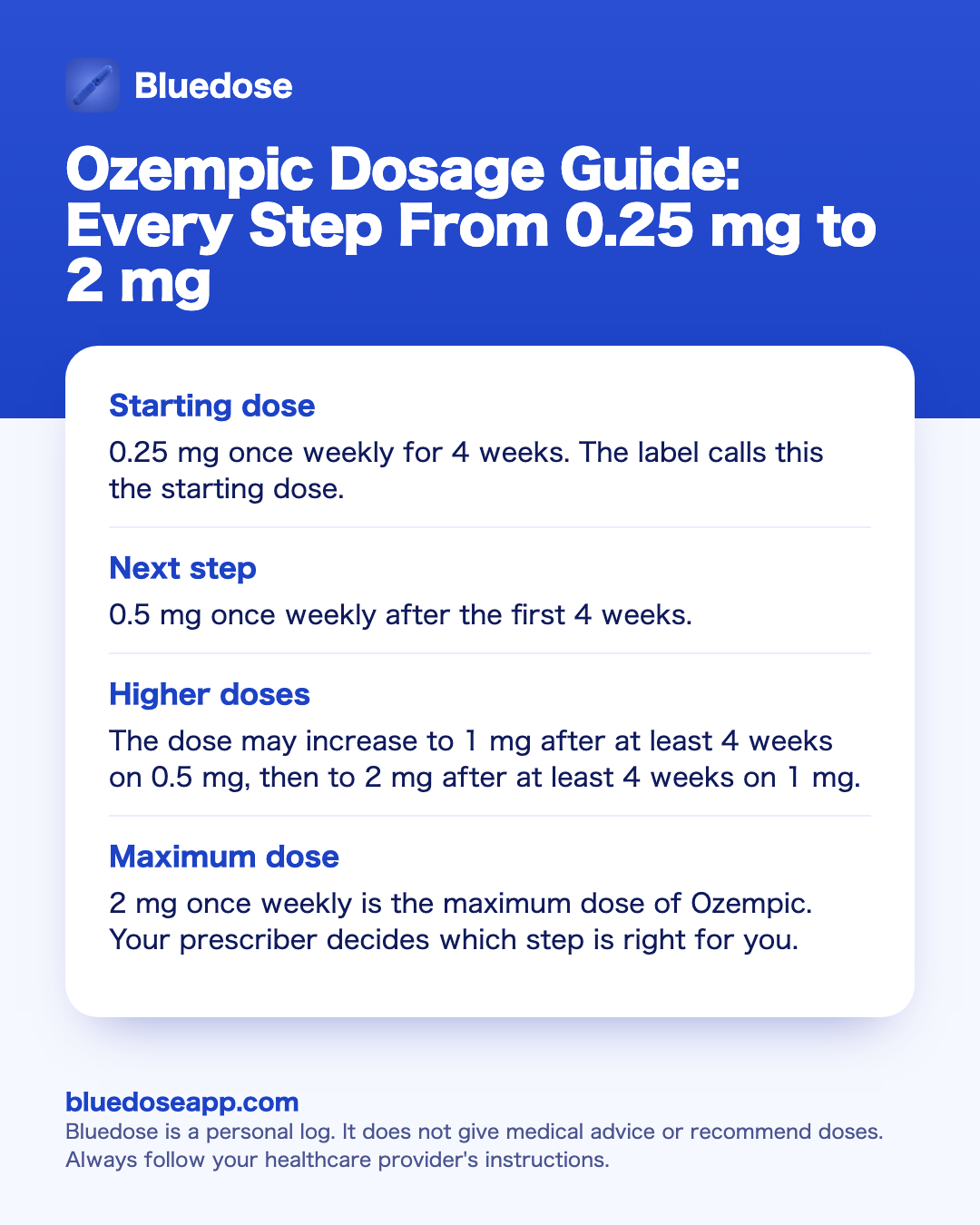
- Starting dose0.25 mg once weekly for 4 weeks. The label calls this the starting dose.
- Next step0.5 mg once weekly after the first 4 weeks.
- Higher dosesThe dose may increase to 1 mg after at least 4 weeks on 0.5 mg, then to 2 mg after at least 4 weeks on 1 mg.
- Maximum dose2 mg once weekly is the maximum dose of Ozempic. Your prescriber decides which step is right for you.

Best overall: Bluedose
Bluedose will not tell you what dose to take. It records the dose your prescriber gave you, with the time and the injection site, so you always know how many weeks you have been on 0.25 mg, 0.5 mg, 1 mg or 2 mg. Side effect check-ins with notes sit right next to each dose change, which makes the next conversation with your prescriber clear and specific.
Free on the App StoreThe Ozempic dose schedule from 0.25 mg to 2 mg
The Ozempic prescribing information lays out a stepwise schedule. Everyone starts in the same place, and the dose only moves up after time on the current step. Ozempic is semaglutide, labeled for type 2 diabetes, and it is injected once weekly.
Here is the schedule as the label describes it:
- Weeks 1 to 4: 0.25 mg once weekly. This is the starting dose.
- After week 4: 0.5 mg once weekly.
- 1 mg once weekly: the dose may increase to 1 mg after at least 4 weeks on 0.5 mg.
- 2 mg once weekly: the dose may increase to 2 mg after at least 4 weeks on 1 mg. This is the top of the schedule.
Two words in the label matter a lot: may and at least.
May means the step up is an option, not a rule. The label does not say every person moves to 1 mg or 2 mg. Many people stay on 0.5 mg or 1 mg. Your prescriber looks at how you are doing and decides whether you stay or step up.
At least 4 weeks is a minimum, not a deadline. The label does not set a date when you must move up. Some people spend months on one dose. That is normal and fits the label.
If you want the whole schedule as a simple grid to keep on hand, see the Ozempic dosage chart. The table further down this page also shows each step at a glance.
What is the maximum dose of Ozempic?
The maximum dose of Ozempic is 2 mg once weekly. The label reaches 2 mg only after at least 4 weeks on 1 mg, and there is no step above it.
People often mix this up with Wegovy. Both products contain semaglutide, but each has its own label and its own pens:
- Ozempic: 0.25 mg, 0.5 mg, 1 mg, then a maximum of 2 mg.
- Wegovy: 0.25 mg, 0.5 mg, 1 mg, 1.7 mg, then 2.4 mg from week 17.
So a 2.4 mg dose belongs to the Wegovy schedule, not the Ozempic one. If you are comparing the two, the Wegovy dosage guide walks through that schedule week by week. Do not swap pens between the two products. Check your pen's leaflet to see which dose your pen delivers, and ask your pharmacist if the label on the box does not match what you expected.
Compounded semaglutide works differently. It comes in vials at different strengths, and the amount you draw up in units depends on the vial's mg/mL. With a U-100 insulin syringe (100 units = 1 mL), the math is:
- mL = dose (mg) / strength (mg/mL)
- units = mL x 100
Compounded drugs are not FDA-approved, and the pharmacy's label is the one to follow. The compounded semaglutide dosage guide explains vials in more detail. Branded Ozempic pens do not use this unit math.
Side effects around an Ozempic dose increase
The prescribing information lists the most common side effects as:
- nausea
- diarrhea
- vomiting
- constipation
- stomach (abdominal) pain
- indigestion
- decreased appetite
Tiredness, burping and injection-site reactions also appear. These side effects are usually most common when starting or after a dose increase. That makes the first weeks on 0.25 mg, and the weeks after each move to 0.5 mg, 1 mg or 2 mg, the times worth watching most closely.
A short note after each dose change will help you and your prescriber. Write down what you felt, on which day, and how long it lasted. A pattern like 'nausea for two days after the first 1 mg shot, then fine' is far more useful at an appointment than a vague memory. A side effect tracker keeps these notes next to the dose that came before them.
The label also lists serious side effects that need medical help:
- severe stomach pain that may reach the back (possible pancreatitis)
- gallbladder problems
- low blood sugar, especially with insulin or sulfonylureas
- kidney problems from dehydration
- serious allergic reactions
- diabetic eye problems
- stomach emptying problems
- possible thyroid C-cell tumors (a boxed warning; Ozempic is not used with a personal or family history of medullary thyroid cancer or MEN 2)
For the full list and what each one means, read the Ozempic side effects guide. If something feels serious, contact a doctor or seek urgent care rather than waiting for your next appointment.
Missed an Ozempic dose? What the label says
A weekly shot is easy to forget, especially in the first months. The Ozempic label gives a clear rule:
- Within 5 days of the missed dose: take it as soon as possible.
- More than 5 days have passed: skip the missed dose and take the next one on your regular day.
The rule is the same at every step of the schedule, from 0.25 mg to 2 mg. It is different from the rules for Mounjaro, Zepbound and Wegovy, so do not apply another product's rule to Ozempic.
The hard part is often knowing exactly when your last shot was. 'Was it Sunday or Monday?' is a real question after a busy week. A dated log answers it in seconds. The missed dose Ozempic guide covers this in more detail, including what to do when you are close to the 5-day line. If you are unsure, ask your prescriber or pharmacist before you inject.
Giving each dose: injection sites and storage
The dose is only part of the routine. Where you inject and how you store the pen matter too.
Injection sites. The label says to inject under the skin of:
- the stomach area (abdomen), at least 2 inches (5 cm) from the belly button
- the front of the thigh
- the back of the upper arm (often with help from someone else)
Rotate the injection site with each dose. You can use the same body area, but pick a different spot each week. The Ozempic injection sites guide shows each area and how to rotate through them.
Storage. Before first use, keep the pen in the refrigerator at 2 to 8 °C (36 to 46 °F), in the carton and away from light. Do not freeze it, and do not use a pen that has frozen. After first use, the label says the pen can be kept in the fridge or at room temperature (up to 30 °C / 86 °F) for 56 days. Writing down the date you first used a pen makes that 56-day window easy to track. The guide on how to store Ozempic covers travel, fridge mistakes and more.
How long each Ozempic dose stays in your body
According to the prescribing information, semaglutide has an elimination half-life of about 1 week (7 days). After the last dose, it takes about 5 weeks to clear from the body.
This helps explain a few things people notice:
- The drug from one weekly shot is still in your body when the next shot is due.
- Stopping does not end its effects overnight; semaglutide takes weeks to leave.
- The timing of each dose is worth recording, because the gap between shots is what the missed-dose rule is built on.
For more on this, see how long does Ozempic stay in your system.
A full dose history also answers practical questions later. When did you move from 0.5 mg to 1 mg? How many weeks were you on 1 mg before your prescriber raised it? Did the nausea start after the change or before? A GLP-1 tracker that saves every shot with its dose, date and site turns those questions into a quick scroll instead of a guess.
Ozempic dose schedule at a glance
This table shows the Ozempic schedule as the prescribing information describes it. It is not a personal plan. Your prescriber decides which step you take and when.
| Step | Weekly dose | Time on this step (label) | Notes |
|---|---|---|---|
| Start | 0.25 mg | 4 weeks | Starting dose for everyone |
| Step 2 | 0.5 mg | At least 4 weeks before any increase | The dose after the starting weeks |
| Step 3 (if prescribed) | 1 mg | At least 4 weeks before any increase | May increase from 0.5 mg after at least 4 weeks |
| Step 4 (if prescribed) | 2 mg | No higher step | Maximum dose of Ozempic |
When a notes app, calendar or paper log is enough
For many people that is enough. If you are on a steady Ozempic dose, rarely miss a shot and feel well, a simple record will do the job.
- Phone calendar: a repeating weekly event works as a reminder, and you can add the dose to the event title.
- Notes app: one line per shot with the date, dose and spot is quick to type.
- Paper log: a card in the carton or on the fridge is easy to see and needs no setup.
These options are free, familiar and already on your phone or kitchen counter. They are fair choices.
Their limits show up over time. A calendar does not remember which injection spot you used last week. Notes get long and hard to search. Side effect notes end up in a different place from dose notes. Paper stays at home when you travel. And none of them will show you a trend in weight or food noise across a dose change without extra work.
When you need more than a simple note
- You are stepping up through 0.25 mg, 0.5 mg, 1 mg or 2 mg and want a clear record of how long you spent on each dose.
- You want help rotating injection sites so you are not guessing which spot you used last week.
- You get side effects after a dose increase and want dated notes to share with your prescriber.
- You want to see weight, protein and food noise over time, next to your dose history.
- You want all of this private, with no account and no ads, stored on your iPhone and in your own iCloud.
How to start tracking your Ozempic dose with Bluedose
Install Bluedose
Download Bluedose: GLP-1 Tracker, free on the App Store. It runs on iPhone with iOS 18 or later. There is no account to create.
Add Ozempic and your schedule
Choose Ozempic, set a weekly schedule and pick a reminder time. On shot day, a Lock Screen card with a Log Shot button appears.
Log each shot with your prescribed dose
Type the dose your prescriber gave you, then tap the spot on the body map where you injected. Bluedose remembers the rotation and suggests the next site.
Check in after dose changes
Record side effects and food noise with short notes, especially in the weeks after a move to a new dose. Add protein with one tap if you track it.
Review your history before appointments
Open your shot history and trends to see every dose, date and note. On supported devices, you can ask questions about your own logs with Apple Intelligence.
FAQ
What is the starting dose of Ozempic?
The prescribing information starts everyone at 0.25 mg once weekly for 4 weeks. The label calls this the starting dose. After those 4 weeks, the label schedule moves to 0.5 mg once weekly. Your prescriber will confirm when you make that change.
What is the maximum dose of Ozempic?
The maximum dose of Ozempic is 2 mg once weekly. The label allows a step to 2 mg only after at least 4 weeks on 1 mg. There is no higher Ozempic step on the label. Wegovy, a different semaglutide product, has its own separate schedule.
How long do you stay on each Ozempic dose?
The label sets a minimum of at least 4 weeks on the current dose before an increase. It does not set a maximum. The label says the dose 'may' increase, so moving up is not automatic. Some people stay on one dose for a long time. Follow your prescriber on when, or whether, to change.
Is the Ozempic dose the same as the Wegovy dose?
No. Both contain semaglutide, but they have different labels. Ozempic goes 0.25 mg, 0.5 mg, 1 mg and a maximum of 2 mg. Wegovy goes 0.25 mg, 0.5 mg, 1 mg, 1.7 mg and then 2.4 mg from week 17. The pens are not interchangeable, so check your pen's leaflet and ask your pharmacist if anything is unclear.
What should I do if I miss an Ozempic dose?
The Ozempic label says to take the missed dose as soon as possible within 5 days of the missed dose. If more than 5 days have passed, the label says to skip it and take the next dose on your regular day. If you are unsure which applies to you, ask your prescriber or pharmacist.
Can Bluedose tell me what Ozempic dose to take?
No. Bluedose is a personal log. It does not give medical advice and does not recommend or calculate doses. You type the dose your prescriber gave you, and Bluedose records it with the time and injection site.
How long does an Ozempic dose stay in your body?
According to the prescribing information, semaglutide has an elimination half-life of about 1 week (7 days). It takes about 5 weeks to clear from the body after the last dose.
The bottom line on Ozempic dosage
The Ozempic label schedule is simple on paper: 0.25 mg once weekly for 4 weeks, then 0.5 mg, with possible steps to 1 mg and a maximum of 2 mg, each after at least 4 weeks on the current dose. Moving up is not automatic, and staying on a dose for a long time is normal. Your prescriber decides each step, and the missed-dose rule (within 5 days) stays the same at every dose.
A calendar or paper note is enough for many people on a steady dose. If you are working through dose changes, rotating sites and noting side effects, a dedicated log like Bluedose keeps it all in one private place, without telling you what to take. This is general information, not medical advice.
Sources
Save this guide
Keep the key points as an image on your phone.
Log every Ozempic dose in one place
Start for free and log each Ozempic shot, site and side effect on your iPhone.
Free on the App Store