Bluedose


Quick answer
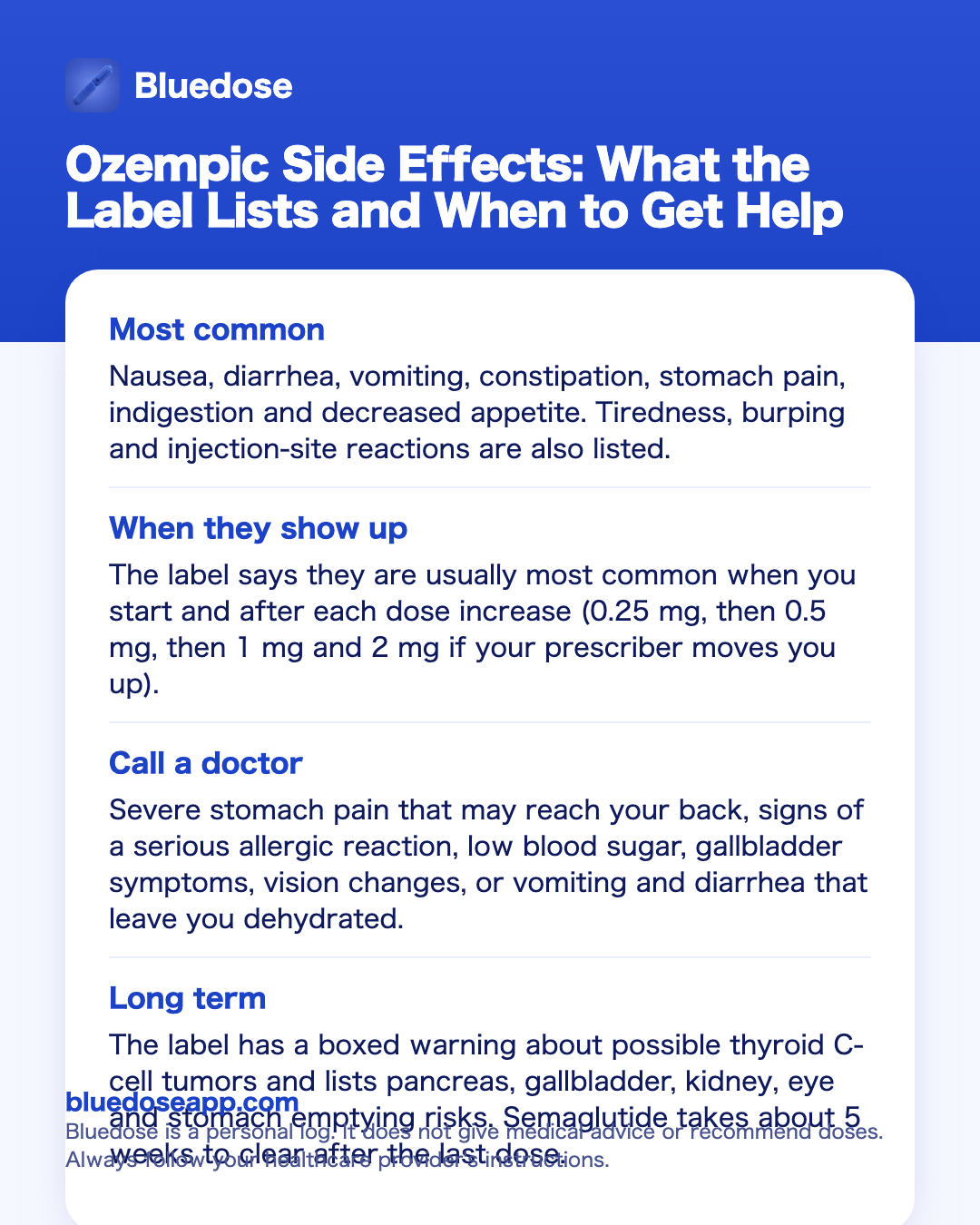
- Most commonNausea, diarrhea, vomiting, constipation, stomach pain, indigestion and decreased appetite. Tiredness, burping and injection-site reactions are also listed.
- When they show upThe label says they are usually most common when you start and after each dose increase (0.25 mg, then 0.5 mg, then 1 mg and 2 mg if your prescriber moves you up).
- Call a doctorSevere stomach pain that may reach your back, signs of a serious allergic reaction, low blood sugar, gallbladder symptoms, vision changes, or vomiting and diarrhea that leave you dehydrated.
- Long termThe label has a boxed warning about possible thyroid C-cell tumors and lists pancreas, gallbladder, kidney, eye and stomach emptying risks. Semaglutide takes about 5 weeks to clear after the last dose.

Best overall: Bluedose
Bluedose lets you log each Ozempic shot and add a side-effect check-in with notes in a few taps, so you will see whether nausea follows your shot day or a dose increase. Everything stays on your iPhone and in your own private iCloud, with no account, and your full history is ready to show your prescriber. It is a personal log and does not give medical advice.
Free on the App StoreCommon side effects of Ozempic: the label list
The Ozempic prescribing information names a short set of side effects as the most common. Most of them involve the stomach and gut:
- Nausea
- Diarrhea
- Vomiting
- Constipation
- Stomach (abdominal) pain
- Indigestion
- Decreased appetite
The wider list also includes tiredness, burping and reactions at the injection site.
Common does not mean everyone gets them. It also does not mean they are harmless when they are severe. A side effect is called common on a label because it is reported often, not because it is always mild.
These are the same kinds of effects seen across the drug class. Our guide to GLP-1 side effects covers the class as a whole. If you are comparing medicines, Wegovy side effects covers the weight medicine that uses the same active ingredient, semaglutide.
Decreased appetite deserves its own note. Many people on GLP-1 medicines say their "food noise", the constant thoughts about food, gets quieter. Food noise is a user term, not a label term, but it sits close to the appetite change the label describes. A food noise tracker will help you see whether quieter food thoughts line up with your shot day or your dose.
Lower appetite also changes what and how much you eat. On days you feel sick, write down what you managed to eat and drink. That small note will make patterns easier to spot later.
When side effects of Ozempic show up
The label says the common side effects are usually most common when starting and after a dose increase. That makes the dose schedule the first place to look when you feel unwell.
The Ozempic prescribing information describes this schedule:
- Weeks 1 to 4: 0.25 mg once weekly. This is a starting dose.
- Then: 0.5 mg once weekly.
- After at least 4 weeks on 0.5 mg: the dose may increase to 1 mg.
- After at least 4 weeks on 1 mg: the dose may increase to 2 mg, the maximum.
The label uses the word "may", so moving up is not automatic. Your prescriber decides whether and when you change dose. Follow your prescriber, not the calendar. The full table is in our Ozempic dosage chart.
What this means for tracking is simple. When you note a side effect, also note:
- the dose you are on
- how many days it has been since your last shot
- whether you recently moved up a dose
A note like "nausea on the first two days after each shot, stronger in the week after moving to 1 mg" gives your prescriber something specific to work with. "I felt sick sometimes" does not. The more exact your notes, the better the conversation at your next visit.
Serious Ozempic side effects: when to call a doctor
The prescribing information also lists serious side effects. These need medical attention, not just a line in your log. Seek medical help if you notice signs of:
- Pancreatitis: severe stomach pain that may reach your back.
- Gallbladder problems. The patient leaflet lists the symptoms. Read it, and ask your pharmacist if anything is unclear.
- Low blood sugar, especially if you also take insulin or a sulfonylurea.
- Kidney problems from dehydration. Vomiting and diarrhea mean losing fluid, so treat this warning as part of the stomach side effects picture.
- Serious allergic reactions.
- Diabetic eye problems, which the label lists for semaglutide. Tell your doctor about changes in your vision.
- Stomach emptying problems.
- Possible thyroid C-cell tumors, the boxed warning covered in the next section.
If a reaction feels sudden or severe, get help right away. Do not wait for your next appointment, and do not wait to see whether the next shot feels better.
If you are unsure whether something counts as serious, call your prescriber or pharmacist and describe it. A clear record of when it started, how strong it is and what dose you are on will make that call faster.
Also tell your prescriber about common side effects that do not settle, that stop you eating or drinking, or that change your daily life. Do not change your dose or skip a shot on your own. Follow your prescriber.
Long term side effects of Ozempic: what the label covers
People searching for long term side effects of Ozempic usually want to know which risks stay with them over months and years. The prescribing information does not sort side effects by time. It does carry a boxed warning:
- Ozempic may cause thyroid C-cell tumors.
- Do not use it if you or a family member has had medullary thyroid cancer, or if you have MEN 2.
The rest of the serious list, which includes pancreatitis, gallbladder problems, kidney problems from dehydration, diabetic eye problems and stomach emptying problems, is not tied to the starting weeks. Keep it in mind for as long as you take Ozempic.
For questions about your own long-term risk, ask your prescriber. They know your history and your other medicines. A website does not.
You may also have seen the phrase "Ozempic face" online. Our page on Ozempic face explains what people mean by it.
Long-term records are where a log earns its place. A few weeks of notes will show how you handle a dose change. A year of check-ins will show whether something new has appeared, whether an old side effect has come back, and how it lines up with your doses and your weight. That kind of history is hard to rebuild from memory in a ten-minute appointment.
How long Ozempic side effects can last
Semaglutide, the active ingredient in Ozempic, has an elimination half-life of about 1 week. The prescribing information says it takes about 5 weeks to clear from the body after the last dose.
Two things follow from that:
- The medicine does not stop working the day after a shot. Each weekly dose stays in your body for weeks.
- Stopping does not end its effects overnight. If you and your prescriber decide to stop, semaglutide will still be in your body for some weeks afterward.
Our guide on how long Ozempic stays in your system explains the half-life in more detail.
The label does not give a set number of days for how long nausea or other common effects last. It says they are usually most common at the start and after a dose increase. Your own log is the best record of how long they last for you.
If feeling unwell has made you miss a shot, the label rule is: take it as soon as possible within 5 days of the missed dose. If more than 5 days have passed, skip it and take the next dose on the regular day. Feeling sick is a reason to call your prescriber. It is not a reason to change the schedule on your own.
How to log side effects for your doctor
A good side-effect log is short and consistent. For each entry, write down:
- Date and time you noticed it
- Days since your last shot
- Your current dose, as your prescriber gave it
- The symptom and how strong it felt, in your own words (mild, moderate, severe)
- What you ate and drank that day, if it seems related
- Injection site and any redness or soreness there
Injection-site reactions are on the label list, so note where each shot went. Our guide to Ozempic injection sites covers the stomach area, thigh and upper arm, and why the label says to rotate.
A dedicated side effect tracker puts these entries next to your shots automatically. Before an appointment, a side effects log for your doctor turns weeks of notes into a short summary you will be able to read out or show on your phone.
If you want everything in one place, an Ozempic app like Bluedose keeps your shot history, side-effect check-ins, food noise, protein and weight together, on your iPhone, with no account.
Ozempic side effects at a glance
The rows below follow the Ozempic prescribing information. The last column is general guidance on logging and getting help, not a treatment plan.
| Side effect | Common or serious | What the label says | What to do |
|---|---|---|---|
| Nausea | Common | Among the most common; usually most common when starting or after a dose increase | Log it with date and dose; tell your prescriber if it does not settle |
| Diarrhea | Common | Listed as a most common side effect | Log it; watch your fluids and see the kidney row |
| Vomiting | Common | Listed as a most common side effect | Log it; call your prescriber if you cannot keep fluids down |
| Constipation | Common | Listed as a most common side effect | Log it; ask your prescriber or pharmacist |
| Stomach pain, indigestion | Common | Listed as most common side effects | Log it; severe pain that may reach your back needs medical help |
| Decreased appetite | Common | Listed as a most common side effect | Log food noise and what you eat |
| Tiredness, burping | Common | Also on the list | Log them with your shot day |
| Injection-site reactions | Common | Also on the list; rotate the site with each dose | Record the site of every shot |
| Pancreatitis | Serious | Severe stomach pain that may reach the back | Seek medical help |
| Gallbladder problems | Serious | Listed as a serious side effect | Read the leaflet's symptom list; contact your doctor |
| Low blood sugar | Serious | Especially with insulin or sulfonylureas | Contact your doctor; follow your prescriber |
| Kidney problems | Serious | From dehydration | Contact your doctor if vomiting or diarrhea leave you dehydrated |
| Serious allergic reaction | Serious | Listed as a serious side effect | Get medical help right away |
| Diabetic eye problems | Serious | Listed for semaglutide | Tell your doctor about vision changes |
| Stomach emptying problems | Serious | Listed as a serious side effect | Contact your doctor |
| Thyroid C-cell tumors | Serious (boxed warning) | Do not use with a personal or family history of medullary thyroid cancer or with MEN 2 | Discuss your history with your prescriber |
When a notes app or paper log is enough
You do not need an app to track Ozempic side effects. A phone note, a calendar entry or a paper log will do the job, and for many people that is enough.
A simple log works well if:
- you are on a steady dose
- your side effects are mild and come and go
- you see your prescriber regularly and they ask how you have been
In that case, one line per day is plenty: the date, your dose, and a few words on how you felt. Paper has real advantages. It is easy to hand over, it needs no setup, and it will not get lost in an app you stop opening. A calendar is good at one thing in particular: it shows your shot day at a glance.
The limits show up over time. A notes app will not link a side effect to the shot before it, will not remind you on shot day, and will not show a trend. After a few months, finding the week you moved up a dose means scrolling and guessing.
When you need more than notes
- You are starting Ozempic or moving up a dose and want each side effect saved next to the shot before it.
- You want a reminder at a time you choose and a Lock Screen card with a Log Shot button on shot day, so the times in your log are right.
- You want to record injection sites on a body map and have the rotation remembered for you.
- You want weight, protein and food noise trends over time, alongside your side-effect check-ins.
- You want to ask questions about months of your own logs instead of scrolling through notes.
How to start tracking Ozempic side effects with Bluedose
Download Bluedose
Bluedose: GLP-1 Tracker is free on the App Store for iPhone (iOS 18 or later). There is no account to create.
Set your Ozempic schedule
Choose Ozempic, pick a weekly schedule and set a reminder at the time you choose. On shot day, a Lock Screen card gives you a Log Shot button.
Log each shot
Record the drug, the dose your prescriber gave you and the time in a tap. Tap the body map to save the injection site; Bluedose remembers the rotation and suggests the next site.
Add side-effect check-ins
When you feel nausea, constipation or anything else, add a check-in with notes. Add food noise check-ins too, and log protein with one tap.
Review before your appointment
Open your history to see every shot and check-in. On supported devices, use Ask, powered by Apple Intelligence, to ask about your own logs, such as "Is my food noise changing?"
FAQ
What are the most common Ozempic side effects?
The prescribing information lists nausea, diarrhea, vomiting, constipation, stomach (abdominal) pain, indigestion and decreased appetite as the most common. Tiredness, burping and injection-site reactions also appear. The label says these are usually most common when you start and after a dose increase. If one of them is severe or does not settle, tell your prescriber.
How long do side effects of Ozempic last?
The label does not give a set number of days. It says the common side effects are usually most common when starting and after a dose increase. Semaglutide has a half-life of about 1 week and takes about 5 weeks to clear after the last dose, so its effects do not stop the day after a shot. A simple log of how you feel each day will show how long side effects last for you.
What are the long term side effects of Ozempic?
The prescribing information does not sort side effects by time. It carries a boxed warning about possible thyroid C-cell tumors and says not to use Ozempic with a personal or family history of medullary thyroid cancer or with MEN 2. It also lists pancreatitis, gallbladder problems, kidney problems from dehydration, diabetic eye problems and stomach emptying problems. Ask your prescriber about your own long-term risk.
When should I call a doctor about Ozempic side effects?
Seek medical help for severe stomach pain that may reach your back, signs of a serious allergic reaction, or any sudden or severe symptom. Call your prescriber about gallbladder symptoms, low blood sugar (especially if you also take insulin or a sulfonylurea), changes in vision, and vomiting or diarrhea that leaves you dehydrated. Also call about mild side effects that do not settle.
Do side effects get worse after an Ozempic dose increase?
The label says the common side effects are usually most common when starting and after a dose increase. The schedule moves from 0.25 mg to 0.5 mg, and may then go to 1 mg and 2 mg, each after at least 4 weeks. Your prescriber decides if and when you move up. Logging your dose next to each side effect will show whether a step up changed how you feel.
Should I skip a dose if Ozempic makes me feel sick?
Do not decide that on your own. Call your prescriber, describe what you feel and follow their advice. For missed doses, the label says to take the dose as soon as possible within 5 days, and if more than 5 days have passed, to skip it and take the next dose on the regular day. Your prescriber will tell you how that applies to you.
Can Bluedose tell me if a side effect is serious?
No. Bluedose is a personal log. It records your shots, side-effect check-ins and notes, and shows your history, but it does not give medical advice and does not recommend or calculate doses. If a symptom worries you, contact your prescriber or get medical help. Your Bluedose history will make that conversation clearer.
Bottom line
Ozempic side effects are mostly digestive: nausea, diarrhea, vomiting, constipation, stomach pain, indigestion and lower appetite, usually most common at the start and after a dose increase. The label also lists serious risks, including a boxed warning about thyroid C-cell tumors, pancreatitis, gallbladder, kidney and eye problems. Severe or sudden symptoms need medical help right away, and any change to your dose is a decision for your prescriber.
A paper log or phone note is enough for many people on a steady dose with mild side effects. If you are starting out, moving up a dose, or want your side effects next to every shot, Bluedose keeps that record on your iPhone, privately, ready for your next visit. This is general information, not medical advice.
Sources
Save this guide
Keep the key points as an image on your phone.
Log your Ozempic side effects
Start for free and keep every shot and side-effect check-in on your iPhone, ready for your next appointment.
Free on the App Store