Bluedose


Quick answer
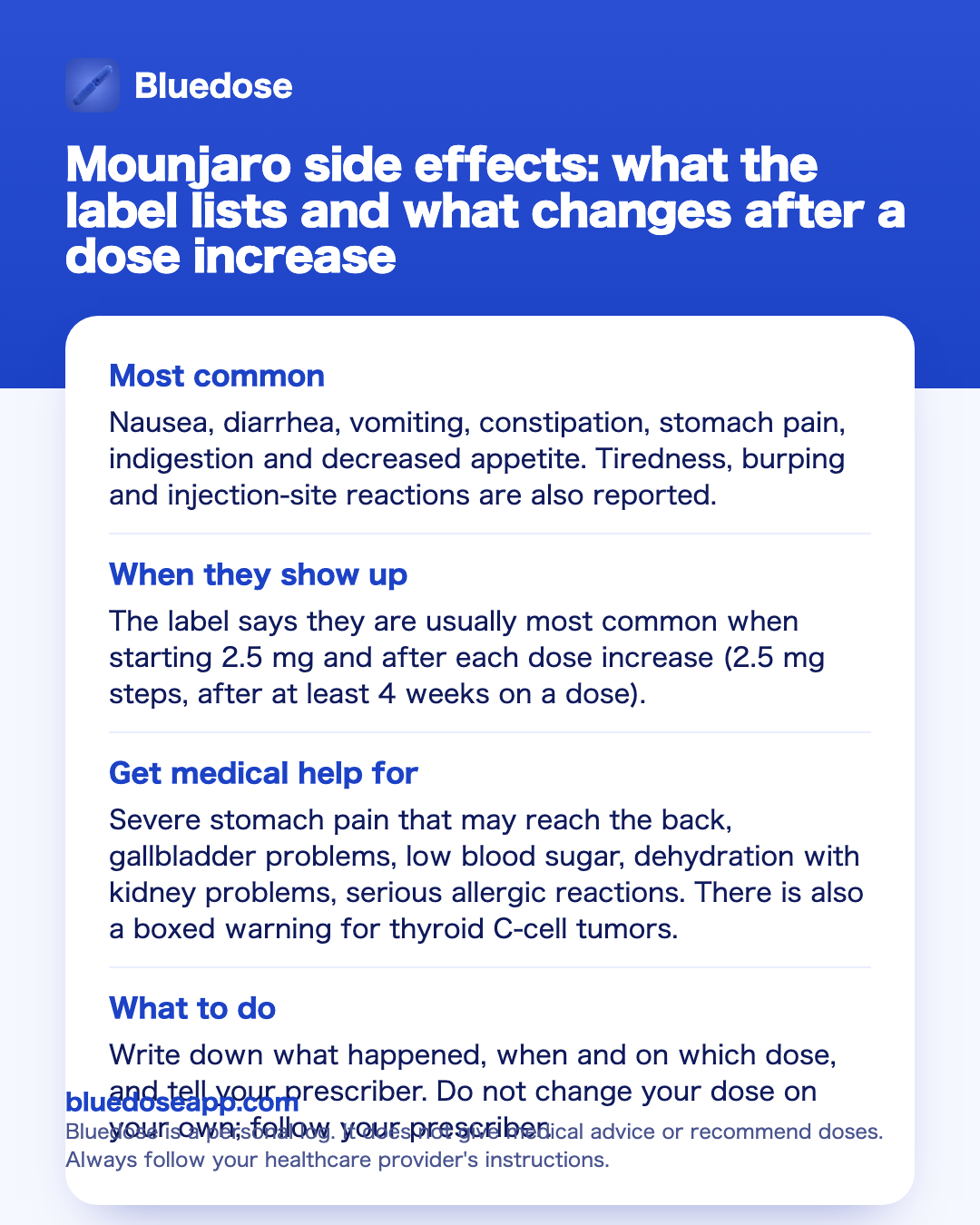
- Most commonNausea, diarrhea, vomiting, constipation, stomach pain, indigestion and decreased appetite. Tiredness, burping and injection-site reactions are also reported.
- When they show upThe label says they are usually most common when starting 2.5 mg and after each dose increase (2.5 mg steps, after at least 4 weeks on a dose).
- Get medical help forSevere stomach pain that may reach the back, gallbladder problems, low blood sugar, dehydration with kidney problems, serious allergic reactions. There is also a boxed warning for thyroid C-cell tumors.
- What to doWrite down what happened, when and on which dose, and tell your prescriber. Do not change your dose on your own; follow your prescriber.

Best overall: Bluedose
Side effects make the most sense next to the dose and the date. Bluedose logs each Mounjaro shot with the dose your prescriber gave, then lets you check in on side effects and food noise with notes, so a rough week after a step up is easy to spot. It stays private on your iPhone with no account, and it does not give medical advice.
Free on the App StoreSide effects of Mounjaro listed on the label
Mounjaro is tirzepatide, a once-weekly injection approved for type 2 diabetes. The prescribing information lists the side effects people report most often. Most of them involve the stomach and gut.
Most common side effects on the label:
- Nausea
- Diarrhea
- Vomiting
- Constipation
- Stomach (abdominal) pain
- Indigestion
- Decreased appetite
The label also mentions tiredness, burping and injection-site reactions at the spot where the pen went in.
The label says these effects are usually most common when you start and after a dose increase. How strong they feel, and how long they last, differs from person to person. That is why your own record matters more than any general list.
Decreased appetite is on the list because tirzepatide changes how hungry you feel. Many users also describe quieter food noise, the constant thoughts about food. Food noise is a user term, not a label term, but it is worth noting next to your side effects so you see the full picture.
Injection-site reactions are easier to manage when you know where each shot went. The label says to inject under the skin of the stomach area (at least 2 inches / 5 cm from the belly button), the front of the thigh or the back of the upper arm, and to rotate the site with each dose. You can use the same body area, just a different spot. Our guide to Mounjaro injection sites covers this in more detail.
Why side effects show up after a Mounjaro dose increase
The label schedule explains the pattern. Mounjaro starts at 2.5 mg once weekly for 4 weeks. 2.5 mg is a starting dose, not a maintenance dose. After at least 4 weeks on the current dose, the dose may go up in 2.5 mg steps: 5, 7.5, 10 and 12.5 mg, up to a maximum of 15 mg once weekly.
Each step is a new, higher dose for your body. The label says the common stomach side effects are usually most frequent when starting and after a dose increase. So a week that feels harder than the last one, right after a step up, fits what the label describes.
A few practical points:
- Note the date of every increase. Without it, you will not be able to tell whether a bad week lines up with a new dose.
- Note which days after the shot feel different. Your own pattern is what your prescriber will want to hear.
- Keep the same format every week. Short notes in the same words are easier to compare than long notes in different words.
- Do not change the schedule on your own. Whether to stay on a dose longer, move up or step back is a decision for your prescriber. Follow your prescriber.
The mounjaro dosage chart lays out every step, and our page on the Mounjaro dose increase explains what to log around a step up. If you are just starting, read first week on Mounjaro.
Serious Mounjaro side effects: when to get medical help
The label also lists less common but serious problems. These need medical help, not a wait-and-see approach.
- Possible thyroid C-cell tumors. This is a boxed warning. Mounjaro should not be used by people with a personal or family history of medullary thyroid cancer or MEN 2 (multiple endocrine neoplasia type 2).
- Pancreatitis. Severe stomach pain that may reach the back.
- Gallbladder problems.
- Low blood sugar, especially if you also take insulin or a sulfonylurea.
- Kidney problems from dehydration. Diarrhea and vomiting lose fluid, and the label links dehydration to kidney problems.
- Serious allergic reactions.
- Stomach emptying problems.
Your pen's leaflet describes the warning signs for each of these. Read it once, keep it somewhere you will find it, and ask your pharmacist if anything is unclear.
If something feels severe or wrong, get medical help first and log it later. A log is useful for the follow-up visit. It is never a reason to wait.
Mounjaro long term side effects: what the label covers
People searching for Mounjaro long term side effects usually want to know two things: are there risks that build over time, and how long the drug stays in the body after the last shot.
On the first question, the label's long-term concerns are the serious warnings above, led by the boxed warning on thyroid C-cell tumors. This page does not add study results or percentages beyond what the prescribing information states. Your prescriber will tell you how the warnings apply to your own health history.
On the second question, Lilly's medical information gives clear numbers for tirzepatide:
- Elimination half-life: about 5 days.
- Mostly gone about 30 days after the last dose.
This matters for side effects. Because tirzepatide leaves the body slowly, its effects do not stop the moment a shot is late or stopped. If your treatment pauses or ends, keep logging how you feel for the weeks after.
Missed doses belong here too. The label says to take a missed Mounjaro dose as soon as possible within 4 days (96 hours). If more than 4 days have passed, skip it and take the next dose on the regular day. Keep at least 3 days (72 hours) between two doses. The missed dose Mounjaro guide walks through the rule. If nausea or vomiting is the reason a dose was missed, tell your prescriber.
How to track Mounjaro side effects so they are useful
A side effect you remember as a bad stretch last month is hard to act on. A short, dated note is not. Good notes answer four questions:
- What happened: nausea, constipation, tiredness, a sore injection spot.
- When it started, counted in days after your shot.
- Which dose you were on, and whether you had just gone up.
- How much it affected eating, drinking, sleep or work.
Add context that helps you read the pattern: your weight, how much protein you got in, and how loud food noise was that week. Decreased appetite is on the label, so a dip in protein during a rough week is worth seeing.
Bring this to appointments. A one-page summary works well as a side effects log for your doctor. A dedicated side effect tracker keeps the dose, the date and the note in one place, so you do not have to rebuild the timeline from memory in the waiting room.
Mounjaro, Zepbound and other GLP-1 side effects
Mounjaro and Zepbound both contain tirzepatide. Mounjaro is approved for type 2 diabetes and Zepbound for weight. They share the same label dose steps: 2.5 mg to start, then 2.5 mg steps after at least 4 weeks on a dose, up to 15 mg once weekly. Check the Zepbound leaflet for its own wording.
Semaglutide (Ozempic, Wegovy) is a different drug with a similar list of common stomach side effects. Its label adds diabetic eye problems to the serious list. Semaglutide also stays in the body longer: an elimination half-life of about 1 week and about 5 weeks to clear.
If you are comparing, see Ozempic side effects and the wider overview of GLP-1 side effects.
Whatever the drug, the same habits apply: log each shot, note each change of dose, and record how you feel in plain words. Those three things will answer most of the questions your prescriber asks.
Mounjaro dose steps and side effects on the label
This table shows the label dose schedule and where side effects are usually most common. It describes the label only. Whether and when you move to the next step is your prescriber's decision.
| Step | Weekly dose | Time on dose (label) | Side effect note | What to log |
|---|---|---|---|---|
| Start | 2.5 mg | 4 weeks | Starting dose, not a maintenance dose. Side effects are usually most common when starting. | Shot date, injection site, how you feel in the days after each shot |
| Step 2 | 5 mg | At least 4 weeks | First increase. Side effects are usually more common after a dose increase. | Date of the increase, any change in nausea or bowel habits |
| Step 3 | 7.5 mg | At least 4 weeks | Another increase; the same pattern may return. | Compare with the weeks after your last step |
| Step 4 | 10 mg | At least 4 weeks | Another increase. | Appetite, protein, fluids, tiredness |
| Step 5 | 12.5 mg | At least 4 weeks | Another increase. | Same notes in the same format |
| Step 6 | 15 mg | Maximum dose | No higher step on the label. | Ongoing check-ins and weight trend |
When a notes app or paper log is enough
For many people that is enough. If your side effects are mild, you are on one dose, and you see your prescriber often, a simple note works fine. The Notes app, a calendar entry on shot day or a sheet of paper on the fridge will hold the basics.
A free log is enough when:
- You write the date, dose and one line about how you feel after each shot.
- You have few side effects and they do not change much from week to week.
- You rarely change dose, so there are no steps to line up against.
- You do not need to rotate sites across many weeks or remember where the last shot went.
The limits show up over time. Notes do not remind you on shot day, do not remember your injection sites, and do not put weight, protein and side effects on one timeline. After two or three dose increases, scrolling back through loose notes to find a pattern gets slow. That is when a Mounjaro app built for weekly shots starts to save time.
When you need more than notes
- You are moving up through dose steps and want to see whether side effects line up with each increase.
- You want a reminder on shot day and a quick way to log the shot from the Lock Screen.
- You want the app to remember your injection sites and suggest the next spot to rotate to.
- You want weight, protein and food noise on one timeline next to your side effect check-ins.
- You want a clean history of every shot to show your prescriber, kept private on your own iPhone.
How to start tracking Mounjaro side effects with Bluedose
Install Bluedose
Download Bluedose: GLP-1 Tracker, free on the App Store for iPhone (iOS 18 or later). There is no account to create, and your data stays on your iPhone and in your own private iCloud.
Set your schedule and reminder
Choose a weekly schedule and the time you want a reminder. On shot day a Lock Screen card shows a Log Shot button, so logging takes a tap.
Log each shot with its site
Pick Mounjaro, type the dose your prescriber gave you, and confirm the time. Tap the spot on the body map; Bluedose remembers your rotation and suggests the next site.
Add side effect check-ins
Check in on side effects and food noise with short notes, and add protein with one tap. Note the date of any dose increase in your notes.
Review before appointments
Open your history of every shot and your trends for weight, protein and food noise. On supported devices, use Ask to question your own logs, powered by Apple Intelligence on the iPhone.
FAQ
What are the most common Mounjaro side effects?
The prescribing information lists nausea, diarrhea, vomiting, constipation, stomach (abdominal) pain, indigestion and decreased appetite as the most common. Tiredness, burping and reactions at the injection spot are also reported. Most of these involve the stomach and gut.
Do Mounjaro side effects get worse after a dose increase?
The label says the common side effects are usually most frequent when starting and after a dose increase. Mounjaro goes up in 2.5 mg steps after at least 4 weeks on the current dose, so each step is a new point where effects may return or change. Note the date of every increase so you will see the pattern. Whether to increase, stay or step back is your prescriber's decision.
How long do side effects of Mounjaro last?
The label does not give one fixed length, and it differs between people. What is known: tirzepatide has an elimination half-life of about 5 days and is mostly gone about 30 days after the last dose, according to Lilly's medical information. Keep a dated log and ask your prescriber if an effect lasts or feels strong.
What are the Mounjaro long term side effects?
The label's long-term concerns are its serious warnings. The boxed warning covers possible thyroid C-cell tumors, and Mounjaro should not be used with a personal or family history of medullary thyroid cancer or MEN 2. Other serious risks include pancreatitis, gallbladder problems, low blood sugar, kidney problems from dehydration, serious allergic reactions and stomach emptying problems. Your prescriber will explain how these apply to you.
When should I get medical help for Mounjaro side effects?
Get medical help for anything on the serious list: severe stomach pain that may reach the back, signs of a serious allergic reaction, signs of low blood sugar, or vomiting and diarrhea that leave you unable to keep fluids down. Your pen's leaflet lists the warning signs. If something feels severe, act first and log it later.
Are Zepbound side effects the same as Mounjaro side effects?
Both contain tirzepatide and follow the same dose steps on the label: 2.5 mg to start, 2.5 mg steps after at least 4 weeks, up to 15 mg once weekly. Mounjaro is approved for type 2 diabetes and Zepbound for weight. Read the Zepbound leaflet for its own wording, and ask your pharmacist about any differences.
Will Bluedose tell me what to do about my side effects?
No. Bluedose is a personal log. It records your shots, doses, injection sites and side effect check-ins with notes, and shows them over time. It does not give medical advice and does not recommend or calculate doses. Take your log to your prescriber, who will decide what to do.
Bottom line
Mounjaro side effects on the label are mostly stomach-related: nausea, diarrhea, vomiting, constipation, stomach pain, indigestion and decreased appetite. They are usually most common at the start and after each dose increase. The serious list, including the boxed thyroid warning, pancreatitis and low blood sugar, needs medical help, and your pen's leaflet describes the signs. Follow your prescriber on every dose decision. This is general information, not medical advice.
A notes app or paper log is a fair place to start, and for many people it is enough. If you are stepping up through doses and want shots, sites and side effects on one timeline, Bluedose keeps that record privately on your iPhone so you will have a clear story to share at your next visit.
Sources
- Mounjaro prescribing information
- Zepbound prescribing information
- Lilly: how long tirzepatide stays in the body
- EMA Mounjaro product information
Save this guide
Keep the key points as an image on your phone.
Log your shots and side effects together
Start for free and keep every Mounjaro dose, site and check-in in one private log on your iPhone.
Free on the App Store