Bluedose


Quick answer
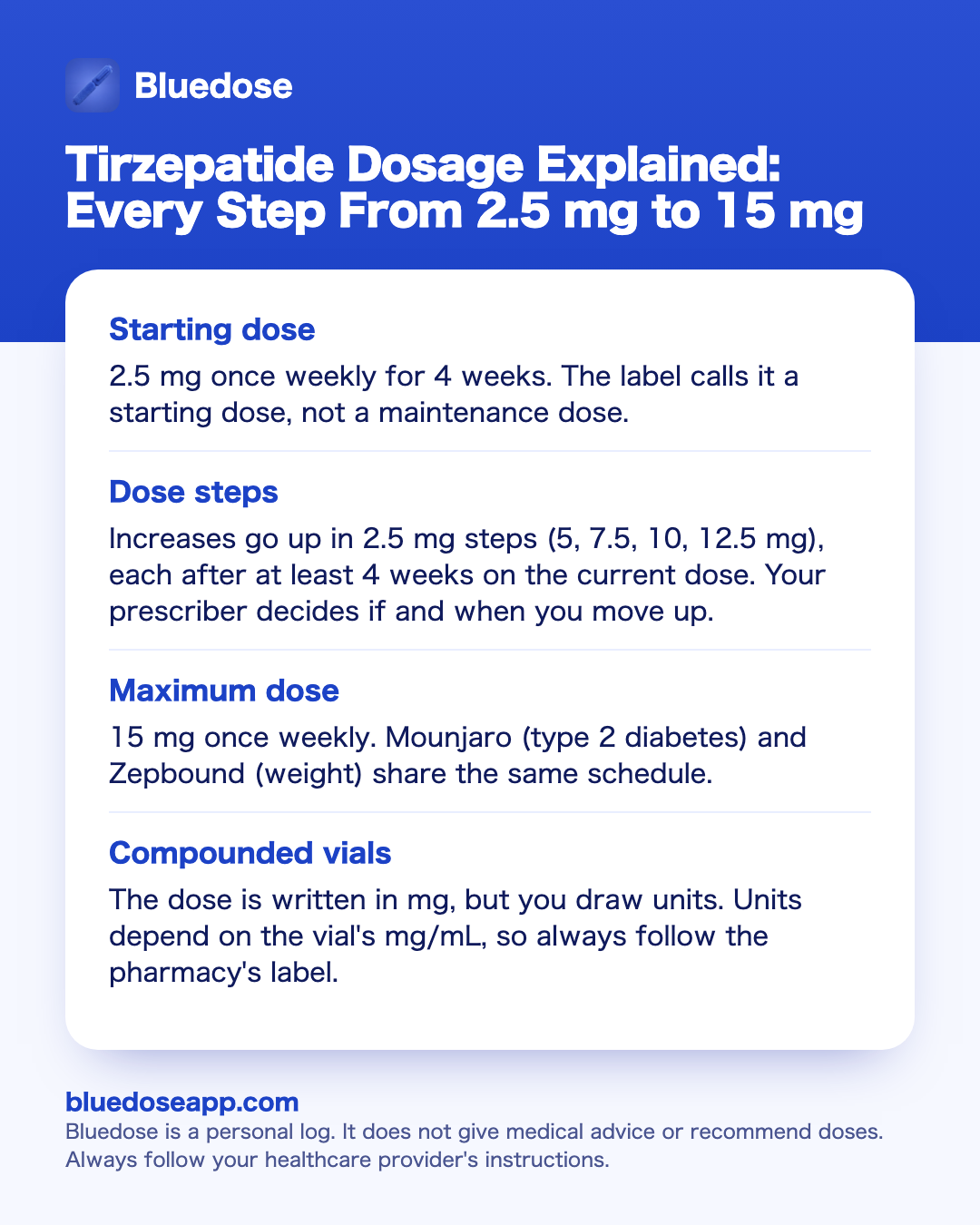
- Starting dose2.5 mg once weekly for 4 weeks. The label calls it a starting dose, not a maintenance dose.
- Dose stepsIncreases go up in 2.5 mg steps (5, 7.5, 10, 12.5 mg), each after at least 4 weeks on the current dose. Your prescriber decides if and when you move up.
- Maximum dose15 mg once weekly. Mounjaro (type 2 diabetes) and Zepbound (weight) share the same schedule.
- Compounded vialsThe dose is written in mg, but you draw units. Units depend on the vial's mg/mL, so always follow the pharmacy's label.

Best overall: Bluedose
Tirzepatide dosage changes in steps every few weeks, and it is easy to lose track of which step you are on and how long you have been there. Bluedose logs each shot with the dose you type in, the time and the injection site, so your history shows every step at a glance. It is a personal log: it records the dose your prescriber gave you and never recommends one.
Free on the App StoreThe tirzepatide dosing schedule on the label
Tirzepatide is the active ingredient in two branded medicines from Lilly: Mounjaro, approved for type 2 diabetes, and Zepbound, approved for weight management. Both are once-weekly injections, and both prescribing information documents describe the same dose steps.
The schedule works like a staircase:
- Weeks 1-4: 2.5 mg once weekly. This is the starting dose. The label is clear that 2.5 mg is for getting started, not for maintenance.
- After at least 4 weeks on 2.5 mg: the dose may go up to 5 mg.
- Further steps: 7.5 mg, 10 mg and 12.5 mg, each increase in 2.5 mg steps after at least 4 weeks on the current dose.
- Maximum: 15 mg once weekly.
Two words in that list matter most: at least. Four weeks is the minimum time on a step, not a deadline to move up. The label describes which steps exist and the shortest time between them. Your prescriber decides which steps you take, how long you stay on each one, and whether you move up at all.
Because the shot is once a week, the dose you take on shot day covers the whole week. That makes the schedule simple on paper. In daily life it stretches over months, with a new number every few weeks, and that is where people lose track. Write down the date you start each step. It answers the most common question you will get at an appointment: how long have you been on this dose?
Mounjaro and Zepbound doses: same drug, same steps
If you search for tirzepatide doses, you will see two brand names. The numbers are the same for both. A 5 mg Mounjaro dose and a 5 mg Zepbound dose contain the same amount of tirzepatide. What differs is the condition each one is approved for, and some practical details like storage. For brand-specific pages, see Mounjaro dosage and Zepbound dosage.
With a branded single-dose pen, the dose is set by the pen you are given. You do not measure anything. Your main job is to make sure the pen in your hand matches the step your prescriber put you on. That check matters most in the week you move up, when an old pen and a new pen may sit side by side in the fridge.
Storage basics from the labels and Lilly:
- Before first use, keep pens in the refrigerator at 2-8 °C (36-46 °F), in the carton, away from light.
- Do not freeze. Do not use a pen that has frozen.
- A Mounjaro single-dose pen can be kept unrefrigerated up to 30 °C (86 °F) for up to 21 days, according to Lilly.
- For Zepbound, check your pen's leaflet for room-temperature limits.
If you switch brands, pharmacies or pen types, ask your pharmacist how the new product maps to your current step. Do not assume the dose carries over until someone confirms it.
Compounded tirzepatide doses: milligrams vs units
Compounded tirzepatide works differently. It usually comes in a vial, not a pen, and vials come in different strengths. Your prescription is written in milligrams (mg), but an insulin syringe measures in units. The number of units you draw depends on the vial's strength in mg/mL.
The math for a U-100 insulin syringe, where 100 units equal 1 mL:
- mL = dose (mg) / strength (mg/mL)
- units = mL x 100
Example: a 2.5 mg dose from a 10 mg/mL vial is 2.5 / 10 = 0.25 mL. Multiply by 100 and you get 25 units. If a vial were half as concentrated, the same 2.5 mg dose would take twice as many units. That is why the units on your syringe are only meaningful next to the strength on your vial.
A few points to keep in mind:
- Compounded drugs are not FDA-approved. Always follow the pharmacy's label for strength, dose and storage.
- If a refill arrives at a different strength, your units will change even when your mg dose stays the same. Check the label every time.
- If anything on the label is unclear, call the pharmacy before you draw a dose.
To check the arithmetic, the tirzepatide dosage calculator converts mg to units from the numbers you enter. It does not choose a dose for you. If you are new to vials, the guide to starting a compounded vial covers the basics of the first weeks.
Going up a dose: what the label says to expect
The labels list the most common side effects of tirzepatide as nausea, diarrhea, vomiting, constipation, stomach pain, indigestion and decreased appetite. Tiredness, burping and injection-site reactions also appear. These are usually most common when starting and after a dose increase. That makes each step on the schedule a natural point to pay attention to how you feel.
The labels also list serious risks that need medical help. These include:
- A boxed warning about possible thyroid C-cell tumors. Tirzepatide is not used by people with a personal or family history of medullary thyroid cancer or MEN 2.
- Pancreatitis, with severe stomach pain that may reach the back.
- Gallbladder problems.
- Low blood sugar, especially with insulin or sulfonylureas.
- Kidney problems from dehydration.
- Serious allergic reactions and stomach emptying problems.
Whether to move up, stay put or step back is a decision for your prescriber. The label gives the minimum timing. It does not say every person moves up at 4 weeks. If side effects are strong, tell your prescriber rather than changing the dose on your own.
What helps that conversation is a record. Note what you felt in the days after each step, how long it lasted and what you were eating. A short side effect log to bring to your doctor turns a vague memory into clear dates. For what a step up looks like week by week, see the guide on the Mounjaro dose increase.
Missed doses, timing and how long tirzepatide lasts
Life gets in the way of shot day. The Mounjaro and Zepbound labels give one rule for a missed dose:
- Take the missed dose as soon as possible within 4 days (96 hours).
- If more than 4 days have passed, skip it and take the next dose on the regular day.
- Keep at least 3 days (72 hours) between two doses.
If you are not sure how many hours have passed, or a missed dose falls near a planned step up, ask your prescriber or pharmacist. The guide on a missed Mounjaro dose walks through common cases.
How long tirzepatide stays in the body: Lilly medical information gives an elimination half-life of about 5 days. Tirzepatide is mostly gone about 30 days after the last dose. This is one reason the weekly schedule works, and one reason to tell your care team about recent doses before a procedure or a change of medicine.
Where to inject: the labels list the stomach area (at least 2 inches / 5 cm from the belly button), the front of the thigh, and the back of the upper arm, which is often easier with help. Rotate the injection site with each dose. You can use the same body area, just a different spot. A simple injection site rotation plan keeps this easy to follow week after week.
Why it helps to track each dose step
A tirzepatide dosing schedule is simple to read and hard to remember. Steps last weeks or months. Side effects tend to show up right after a change. Vial strengths can change between refills. And when you sit down with your prescriber, the useful facts are dates and doses, not impressions.
A good log answers these questions in seconds:
- What dose am I on, and when did I start it?
- When was my last shot, and where did I inject it?
- How did I feel in the first week of each step?
- How has my weight changed since the last increase?
Bluedose is built around that log. It is a GLP-1 tracker for iPhone that works with Mounjaro, Zepbound and compounded tirzepatide:
- Log a shot in a tap: drug, dose (you type the dose your prescriber gave you) and time.
- Body map: tap where you injected. Bluedose remembers the rotation and suggests the next site.
- Schedules: weekly, twice weekly, daily or custom.
- Reminders: a GLP-1 shot reminder at the time you choose, plus a Lock Screen card on shot day with a Log Shot button.
- Check-ins: side effects and food noise, with notes.
- Trends and history: weight, protein and food noise over time, and every shot you have logged.
- Ask: ask questions about your own logs, powered by Apple Intelligence on supported iPhones.
There is no account, no ads and no tracking. Your data stays on your iPhone and in your own private iCloud. Bluedose does not recommend or calculate doses. It keeps the record so you and your prescriber can see each step clearly.
Tirzepatide dosing schedule at a glance
This table shows the steps in the Mounjaro and Zepbound prescribing information. It describes the label, not a plan for you. Your prescriber decides your dose and timing.
| Step | Weekly dose | Time on this dose (label) | Label note |
|---|---|---|---|
| 1 | 2.5 mg | 4 weeks | Starting dose, not a maintenance dose |
| 2 | 5 mg | At least 4 weeks before any increase | First step above the starting dose |
| 3 | 7.5 mg | At least 4 weeks before any increase | Increase of 2.5 mg |
| 4 | 10 mg | At least 4 weeks before any increase | Increase of 2.5 mg |
| 5 | 12.5 mg | At least 4 weeks before any increase | Increase of 2.5 mg |
| 6 | 15 mg | No further steps | Maximum dose once weekly |
When a paper log or your phone's calendar is enough
For many people that is enough. If you use a branded pen, take one shot a week on a fixed day and rarely change anything, a few simple tools cover the basics:
- A paper calendar on the fridge. Tick the day, write the dose and the site.
- A recurring reminder in your phone's Reminders or Calendar app for shot day.
- A note in your phone with the date you started each step.
These cost nothing, need no setup and work fine while your dose is steady. The limits show up over time. Paper does not suggest your next injection site. A calendar does not link a side effect to the step you were on. Notes get long and hard to search. And none of them can show your weight or symptoms on a timeline next to your dose changes.
When you need more than notes
- You are moving through dose steps and want each start date and every shot in one history.
- You use compounded vials and want each logged dose tied to the date, so refills at a new strength are easy to spot.
- You want site rotation remembered for you, with the next site suggested on a body map.
- You want side effects, food noise and weight on a timeline you can show your prescriber.
- You want reminders and a Log Shot button on the Lock Screen on shot day, with no account and data kept on your iPhone.
How to start tracking your tirzepatide dosage with Bluedose
Install Bluedose
Get Bluedose: GLP-1 Tracker, free on the App Store, for iPhone with iOS 18 or later. There is no account to create.
Add your medicine and schedule
Choose Mounjaro, Zepbound or compounded tirzepatide, set a weekly schedule on your shot day, and pick the time for your reminder.
Log each shot with your prescribed dose
On shot day, tap Log Shot, type the dose your prescriber gave you, and tap the spot on the body map where you injected.
Check in after each step
Add side effect and food noise check-ins with notes, log your weight, and use Trends and History to see how each dose step went.
FAQ
What is the starting tirzepatide dosage?
The prescribing information for Mounjaro and Zepbound starts at 2.5 mg once weekly for 4 weeks. The label describes 2.5 mg as a starting dose, not a maintenance dose. It gives your body time to adjust before any increase. Your prescriber sets your actual dose and decides what comes next.
How often do tirzepatide doses go up?
On the label, increases happen in 2.5 mg steps, and each one comes after at least 4 weeks on the current dose. The steps are 5, 7.5, 10, 12.5 and 15 mg. Four weeks is a minimum, not a deadline. Your prescriber decides if and when you move up, so follow your prescriber rather than the calendar.
What is the maximum tirzepatide dose?
The maximum dose in the prescribing information is 15 mg once weekly. That is the top of the schedule for both Mounjaro and Zepbound. Reaching it is not a goal in itself. The right dose for you is the one your prescriber gives you.
Is the tirzepatide dosing schedule the same for Mounjaro and Zepbound?
Yes. Both contain tirzepatide and both labels use the same steps: 2.5 mg for 4 weeks, then 2.5 mg increases after at least 4 weeks on each dose, up to 15 mg. Mounjaro is approved for type 2 diabetes and Zepbound for weight management. Storage details differ, so check your pen's leaflet.
How many units is 2.5 mg of compounded tirzepatide?
It depends on the vial's strength. With a U-100 insulin syringe (100 units = 1 mL), the math is mL = dose (mg) / strength (mg/mL), then units = mL x 100. From a 10 mg/mL vial, 2.5 mg is 0.25 mL, which is 25 units. A different strength gives a different number of units. Compounded drugs are not FDA-approved, so always follow the pharmacy's label.
What happens if I miss a tirzepatide dose?
The Mounjaro and Zepbound labels say to take a missed dose as soon as possible within 4 days (96 hours). If more than 4 days have passed, the label says to skip it and take the next dose on your regular day. Keep at least 3 days (72 hours) between two doses. If you are unsure, ask your prescriber or pharmacist.
Does Bluedose tell me which tirzepatide dose to take?
No. Bluedose is a personal log. You type in the dose your prescriber gave you, and Bluedose records it with the time and injection site. It does not recommend, change or calculate doses, and it does not give medical advice.
Bottom line
The tirzepatide dosage on the label is straightforward: 2.5 mg once weekly for 4 weeks, then 2.5 mg steps after at least 4 weeks on each dose, up to 15 mg. Mounjaro and Zepbound share that schedule. Compounded vials use the same mg doses, but the units you draw depend on the vial's strength, so the pharmacy's label is the one to follow. Your prescriber decides which step you are on and when it changes.
If your dose is steady and you only need a weekly nudge, a paper log or a calendar reminder will do the job. If you are moving through steps, using vials, or want a clear record for your next appointment, a dedicated log like Bluedose keeps every dose, site and check-in in one private place. This is general information, not medical advice.
Sources
- Mounjaro prescribing information
- Zepbound prescribing information
- Lilly: how long tirzepatide stays in the body
- Lilly: Mounjaro pen storage
- EMA Mounjaro product information
Save this guide
Keep the key points as an image on your phone.
Log every tirzepatide step in one place
Bluedose keeps each dose, injection site and check-in in one private log on your iPhone, free on the App Store.
Free on the App Store