Bluedose

Quick answer
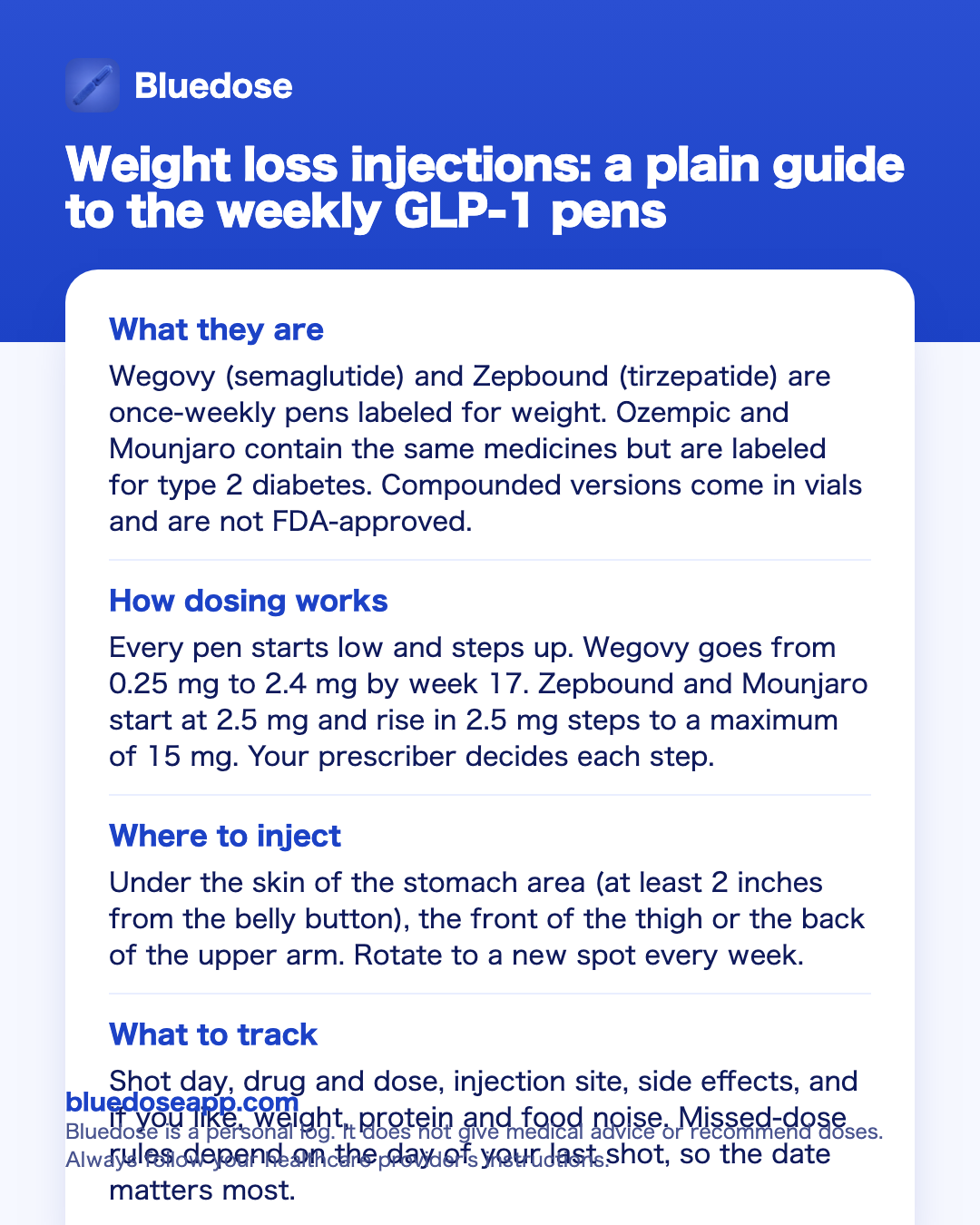
- What they areWegovy (semaglutide) and Zepbound (tirzepatide) are once-weekly pens labeled for weight. Ozempic and Mounjaro contain the same medicines but are labeled for type 2 diabetes. Compounded versions come in vials and are not FDA-approved.
- How dosing worksEvery pen starts low and steps up. Wegovy goes from 0.25 mg to 2.4 mg by week 17. Zepbound and Mounjaro start at 2.5 mg and rise in 2.5 mg steps to a maximum of 15 mg. Your prescriber decides each step.
- Where to injectUnder the skin of the stomach area (at least 2 inches from the belly button), the front of the thigh or the back of the upper arm. Rotate to a new spot every week.
- What to trackShot day, drug and dose, injection site, side effects, and if you like, weight, protein and food noise. Missed-dose rules depend on the day of your last shot, so the date matters most.

Best overall: Bluedose
Whichever weight loss injection you are on, Bluedose logs it in a tap: the drug, the dose your prescriber gave you, the time and the spot on a body map. It works with Wegovy, Zepbound, Ozempic, Mounjaro and compounded semaglutide or tirzepatide, reminds you on shot day, and keeps everything on your iPhone with no account. It is a personal log, so it never recommends or calculates a dose.
Free on the App StoreWhich weight loss injections are approved
Four brand-name pens make up most of what people mean by weight loss injections. They contain one of two medicines: semaglutide or tirzepatide.
- Wegovy (semaglutide) is labeled for weight. It is a once-weekly pen.
- Zepbound (tirzepatide) is labeled for weight. It is also once weekly.
- Ozempic (semaglutide) is labeled for type 2 diabetes. It is the same medicine as Wegovy, with a different label and different dose steps.
- Mounjaro (tirzepatide) is labeled for type 2 diabetes. It is the same medicine as Zepbound, with the same dose steps.
Then there are compounded semaglutide and tirzepatide. These come from pharmacies in vials at different strengths and are drawn up with a syringe. Compounded drugs are not FDA-approved, and the pharmacy's label is the one to follow.
People call all of these weight loss shots or GLP-1 injections. The names overlap, but the pens do not. Each one has its own dose schedule, its own missed-dose rule and its own storage limits. That is why it matters to know exactly which pen or vial is in your fridge, and what strength it is.
Which one you use is a decision for you and your prescriber. This guide describes what the prescribing information says for each, so you can follow along and bring sharper questions to your next visit.
How the doses step up on weight loss shots
Every one of these pens starts low. The first dose is a starting dose, meant to let your body adjust. The label then describes steps up over weeks or months.
Wegovy follows a fixed monthly ladder:
- Weeks 1-4: 0.25 mg once weekly
- Weeks 5-8: 0.5 mg once weekly
- Weeks 9-12: 1 mg once weekly
- Weeks 13-16: 1.7 mg once weekly
- From week 17: 2.4 mg once weekly
The label allows 1.7 mg as a maintenance dose if 2.4 mg isn't tolerated. A higher 7.2 mg option exists in some countries; ask your prescriber. The Wegovy dosage page covers each step in more detail.
Zepbound and Mounjaro share one schedule. Both start at 2.5 mg once weekly for 4 weeks. The dose then goes up in 2.5 mg steps (5, 7.5, 10 and 12.5 mg), each after at least 4 weeks on the current dose. The maximum is 15 mg once weekly. The label is clear that 2.5 mg is a starting dose, not a maintenance dose. See Zepbound dosage and Mounjaro dosage for the step-by-step view.
Ozempic starts at 0.25 mg once weekly for 4 weeks, then moves to 0.5 mg. It may go up to 1 mg after at least 4 weeks, then to 2 mg after at least 4 more weeks. The maximum is 2 mg once weekly. The Ozempic dosage page lays this out week by week.
Compounded vials work in units on a syringe, not in pen doses. The dose in units depends on the vial's strength in mg/mL. With a U-100 insulin syringe (100 units = 1 mL), the math is:
- mL = dose (mg) / strength (mg/mL)
- units = mL x 100
For example, 2.5 mg from a 10 mg/mL vial is 0.25 mL, which is 25 units. The same mg dose will be a different number of units if the vial strength changes. The compounded semaglutide dosage page walks through the math. Always follow the pharmacy's label.
One note on timing: "at least 4 weeks" is a floor, not a deadline. The wording leaves room to stay on a dose longer. Your prescriber decides when, and whether, to move up. Follow your prescriber.
Where and how GLP-1 injections are given
All of these medicines go under the skin. The labels name three areas:
- Stomach area (abdomen), at least 2 inches (5 cm) from the belly button
- Front of the thigh
- Back of the upper arm, which is often easier with help
The labels say to rotate the injection site with each dose, so a new spot every week. You can keep using the same body area as long as you pick a different spot within it. A simple pattern, such as left stomach, right stomach, left thigh, right thigh, makes this easy to follow. The guide to injection site rotation has more ideas.
Storage differs by pen, so check yours:
- Before first use, keep the pen in the refrigerator at 2-8 °C (36-46 °F), in the carton, away from light. Do not freeze it, and do not use a pen that has frozen.
- Mounjaro single-dose pen: can be kept unrefrigerated up to 30 °C (86 °F) for up to 21 days.
- Wegovy single-dose pen: can be kept between 8 °C and 30 °C (46-86 °F) in the carton for up to 28 days.
- Ozempic: after first use, the pen can be kept in the fridge or at room temperature (up to 30 °C / 86 °F) for 56 days.
- Zepbound: check your pen's leaflet.
- Compounded vials: follow the pharmacy's label, or ask your pharmacist.
If you take a pen out of the fridge, write down the date. It is the easiest number to forget and the one you will want when you count the days.
Side effects of GLP-1 injections
The labels for these medicines list a similar set of common side effects:
- Nausea, diarrhea, vomiting and constipation
- Stomach (abdominal) pain and indigestion
- Decreased appetite
- Tiredness, burping and injection-site reactions
These are usually most common when starting or after a dose increase. That is one good reason to note side effects next to each shot. You will see whether they cluster around a step up, and you will have clear notes to share with your prescriber.
The labels also list serious risks. Seek medical help if any of these come up:
- Possible thyroid C-cell tumors (a boxed warning). These medicines are not for people with a personal or family history of medullary thyroid cancer or MEN 2.
- Pancreatitis, with severe stomach pain that may reach the back
- Gallbladder problems
- Low blood sugar, especially with insulin or sulfonylureas
- Kidney problems from dehydration
- Serious allergic reactions
- Diabetic eye problems (semaglutide)
- Stomach emptying problems
Many people also talk about food noise, meaning constant thoughts about food. Many users report it quiets on GLP-1s. It is a user term, not a label term, but it is worth noting how yours changes from week to week. For a fuller picture by drug, see GLP-1 side effects.
Missed doses and how long the shots stay in your body
Each label has its own missed-dose rule. They are close enough to mix up, so it helps to know the one for your pen.
- Mounjaro and Zepbound: take the missed dose as soon as possible within 4 days (96 hours). If more than 4 days have passed, skip it and take the next dose on the regular day. Keep at least 3 days (72 hours) between two doses.
- Ozempic: take it as soon as possible within 5 days of the missed dose. If more than 5 days have passed, skip it and take the next dose on the regular day.
- Wegovy: if the next scheduled dose is more than 2 days (48 hours) away, take the missed dose as soon as possible. If it is less than 2 days away, skip it and take the next dose on the regular day. If more than 2 weeks of doses are missed, the prescriber may restart the dose schedule.
- Compounded: ask your pharmacist or prescriber.
Every one of these rules depends on the date and time of your last shot. To check the window against your own dates, the missed dose calculator does the counting. If you are unsure, call your prescriber or pharmacist before you inject.
How long they stay in the body also differs between the two medicines:
- Tirzepatide (Mounjaro, Zepbound): elimination half-life about 5 days; mostly gone about 30 days after the last dose.
- Semaglutide (Ozempic, Wegovy): elimination half-life about 1 week; about 5 weeks to clear.
The guide on how long does Ozempic stay in your system explains what those numbers mean in daily life, for example around a break or a switch your prescriber has planned.
What to track on weight loss injections
Weekly shots are easy to lose track of. Seven days is long enough to forget which day you injected, which side you used, and whether the nausea started before or after the dose went up. A short log fixes that.
The useful things to write down are:
- Shot day and time, so the next one lands on schedule and missed-dose windows are easy to check
- Drug and dose, exactly as your prescriber gave it, plus the vial strength if you use compounded
- Injection site, so you rotate
- Side effects and food noise, with a short note
- Weight, at whatever rhythm suits you
- Protein, since appetite often drops and meals get smaller
You do not need all of it. Shot day, dose and site cover the basics. The rest helps when you want to see a trend or answer a question at your next appointment. A dedicated GLP-1 tracker keeps it in one place, but a notes app will cover the basics too, as the next sections show.
Weight loss injections compared at a glance
This table summarizes what each prescribing information says. It describes the label schedule, not a personal plan. Your prescriber sets your dose and decides when it changes.
| Medicine | Ingredient and label | Starting dose | Step-up (per label) | Top dose | Missed-dose window | Half-life |
|---|---|---|---|---|---|---|
| Wegovy | Semaglutide, weight | 0.25 mg weekly, weeks 1-4 | 0.5 mg, 1 mg, 1.7 mg, each for 4 weeks | 2.4 mg weekly from week 17 (1.7 mg allowed if 2.4 mg isn't tolerated; 7.2 mg option in some countries) | Take it if the next dose is more than 2 days away | About 1 week |
| Zepbound | Tirzepatide, weight | 2.5 mg weekly for 4 weeks | 2.5 mg steps after at least 4 weeks each | 15 mg weekly | Within 4 days (96 hours); at least 3 days between doses | About 5 days |
| Ozempic | Semaglutide, type 2 diabetes | 0.25 mg weekly for 4 weeks | 0.5 mg, then 1 mg and 2 mg after at least 4 weeks each | 2 mg weekly | Within 5 days | About 1 week |
| Mounjaro | Tirzepatide, type 2 diabetes | 2.5 mg weekly for 4 weeks | 2.5 mg steps after at least 4 weeks each | 15 mg weekly | Within 4 days (96 hours); at least 3 days between doses | About 5 days |
| Compounded semaglutide or tirzepatide | Not FDA-approved; vials at different strengths | Follow the pharmacy's label | Units depend on vial mg/mL | Follow the pharmacy's label | Ask your pharmacist | Same medicine as the brand version |
When a notes app, calendar or paper log is enough
You do not need an app to stay on track with weight loss injections. For many people that is enough:
- A repeating calendar event on shot day handles the reminder.
- A note on your phone with one line per shot (date, dose, site) covers the history.
- A paper log on the fridge, next to the pens, works well if the whole household helps.
This works best when you are on one steady dose, side effects are mild, and you rarely miss a week. It costs nothing and you already know how to use it.
The limits show up over time. A note will not suggest the next injection site. A calendar event does not know whether you logged the shot. Lining up side effects against dose steps means scrolling back through weeks of text. And weight, protein and food noise usually end up in three different places, so trends are hard to see.
When you need more than notes
- You want the app to remember your site rotation and suggest the next spot, instead of keeping a pattern in your head.
- Your dose is stepping up and you want side effects and check-ins sitting next to each shot, so changes are easy to spot.
- You want a reminder on shot day with a Lock Screen card and a Log Shot button, so the reminder and the log are one tap.
- You want weight, protein and food noise trends over time in one view, not spread across notes and spreadsheets.
- You want your full shot history on hand at appointments, kept private on your iPhone with no account.
How to start tracking your shots with Bluedose
Install Bluedose
Get Bluedose: GLP-1 Tracker on the App Store for iPhone (iOS 18 or later). There is no account to create; your data stays on your iPhone and in your own private iCloud.
Add your medicine and schedule
Choose Wegovy, Zepbound, Ozempic, Mounjaro, or compounded semaglutide or tirzepatide. Type the dose your prescriber gave you and set the schedule: weekly, twice weekly, daily or custom.
Set your reminder
Pick the time you want a reminder. On shot day a Lock Screen card appears with a Log Shot button.
Log your shot and site
Log the shot in a tap, then tap the spot on the body map. Bluedose remembers your rotation and suggests the next site for next week.
Add check-ins and watch trends
Note side effects and food noise, add protein with one tap, and log your weight. Trends shows how they change over time, and Ask lets you question your own logs on supported iPhones with Apple Intelligence.
FAQ
What are weight loss injections?
Most people mean the once-weekly pens Wegovy (semaglutide) and Zepbound (tirzepatide), which are labeled for weight. Ozempic and Mounjaro contain the same two medicines but are labeled for type 2 diabetes. Compounded semaglutide and tirzepatide also exist. They come in vials, and they are not FDA-approved.
Are weight loss shots the same as GLP-1 injections?
In everyday talk, yes. People use "weight loss shots" and "GLP-1 injections" for the same group of pens. Each pen still has its own label, dose steps, missed-dose rule and storage limits, so it helps to know exactly which one you use.
What is the difference between Wegovy and Ozempic?
Both contain semaglutide. Wegovy is labeled for weight and steps up monthly from 0.25 mg to 2.4 mg once weekly from week 17. Ozempic is labeled for type 2 diabetes, starts at 0.25 mg and has a maximum of 2 mg once weekly. Their missed-dose rules also differ. Your prescriber decides which one fits you.
What is the difference between Zepbound and Mounjaro?
Both contain tirzepatide and follow the same label schedule: 2.5 mg once weekly for 4 weeks, then 2.5 mg steps after at least 4 weeks on each dose, up to 15 mg. Zepbound is labeled for weight. Mounjaro is labeled for type 2 diabetes.
What happens if I miss my weekly shot?
Each label has its own rule. Mounjaro and Zepbound allow the missed dose within 4 days (96 hours), with at least 3 days between doses. Ozempic allows it within 5 days. Wegovy depends on whether the next dose is more than 2 days away. If you are unsure, ask your prescriber or pharmacist before you inject.
Are compounded weight loss injections the same as Wegovy or Zepbound?
No. Compounded semaglutide and tirzepatide are not FDA-approved. They come in vials at different strengths, and the dose in units depends on the vial's mg/mL. With a U-100 syringe, 2.5 mg from a 10 mg/mL vial is 0.25 mL, or 25 units. Always follow the pharmacy's label.
Which weight loss injections does Bluedose work with?
Bluedose works with Zepbound, Mounjaro, Wegovy, Ozempic, and compounded semaglutide or tirzepatide. You type the dose your prescriber gave you. Bluedose is a personal log, so it does not give medical advice and does not recommend or calculate doses.
Bottom line
Weight loss injections come down to two medicines in a handful of pens: semaglutide in Wegovy and Ozempic, tirzepatide in Zepbound and Mounjaro, plus compounded vials that are not FDA-approved. Each one starts low, steps up on its own schedule, and has its own missed-dose rule and storage limits. Know which pen you use, follow your prescriber, and keep a simple record of every shot.
A notes app or calendar will do that job for many people. If you want site rotation, reminders, side effects and trends in one private place, Bluedose logs whichever injection you are on without recommending or calculating a dose. This is general information, not medical advice.
Sources
- Wegovy prescribing information
- Zepbound prescribing information
- Ozempic prescribing information
- Mounjaro prescribing information
- Lilly: how long tirzepatide stays in the body
Save this guide
Keep the key points as an image on your phone.
Keep every weekly shot in one place
Log your dose, injection site and check-ins in a tap on your iPhone, free on the App Store.
Free on the App Store