Bluedose


Quick answer
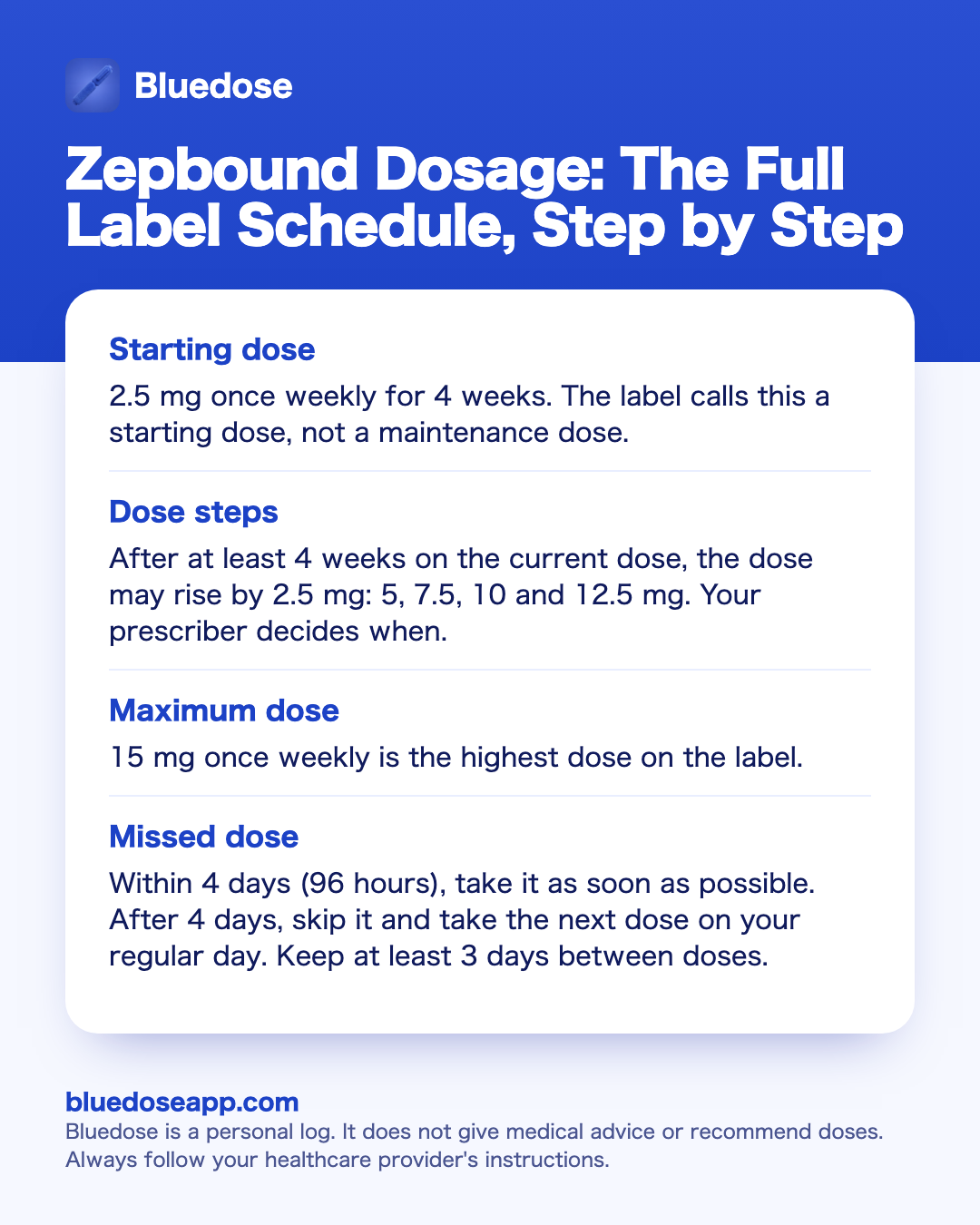
- Starting dose2.5 mg once weekly for 4 weeks. The label calls this a starting dose, not a maintenance dose.
- Dose stepsAfter at least 4 weeks on the current dose, the dose may rise by 2.5 mg: 5, 7.5, 10 and 12.5 mg. Your prescriber decides when.
- Maximum dose15 mg once weekly is the highest dose on the label.
- Missed doseWithin 4 days (96 hours), take it as soon as possible. After 4 days, skip it and take the next dose on your regular day. Keep at least 3 days between doses.

Best overall: Bluedose
Bluedose logs each Zepbound shot with the dose your prescriber gave you, the time and the injection site, so you will always know which step you are on and how many weeks you have been there. It does not recommend or calculate doses. It keeps a clean history of every shot, side effect and weight check-in, ready for your next talk with your prescriber.
Free on the App StoreThe Zepbound dose schedule, step by step
Zepbound is tirzepatide, prescribed for weight. Its prescribing information sets one schedule at the start, then lets your prescriber move the dose up in fixed steps. Every dose is given once weekly.
- Weeks 1 to 4: 2.5 mg once weekly.
- Next step: 5 mg once weekly, after at least 4 weeks on 2.5 mg.
- Next step: 7.5 mg once weekly, after at least 4 weeks on 5 mg.
- Next step: 10 mg once weekly, after at least 4 weeks on 7.5 mg.
- Next step: 12.5 mg once weekly, after at least 4 weeks on 10 mg.
- Maximum: 15 mg once weekly, after at least 4 weeks on 12.5 mg.
The pattern is simple. Each step is 2.5 mg. Each step lasts at least 4 weeks. The highest dose is 15 mg.
The words "at least" matter. The label sets a minimum time on each dose, not a deadline. Your prescriber may keep you on one dose for longer than 4 weeks, and some people will stay on a dose below the maximum. 15 mg is the ceiling of the schedule, not a target you must reach. Where your dose settles is your prescriber's call.
Because the steps are spaced weeks apart, it is easy to lose count. Was the last increase three weeks ago or five? A written log answers that in seconds, which is why many people keep one from the first shot.
Why 2.5 mg is a starting dose
The Zepbound label is clear on one point: 2.5 mg is a starting dose, not a maintenance dose. It is there to begin treatment, and the plan on the label is to move past it after the first 4 weeks.
The slow start fits a pattern the label describes. The most common side effects of tirzepatide are stomach-related:
- nausea
- diarrhea
- vomiting
- constipation
- stomach (abdominal) pain
- indigestion
- decreased appetite
Tiredness, burping and injection-site reactions are also listed. These are usually most common when starting or after a dose increase. That is why the first weeks on 2.5 mg, and the first weeks after each step up, are the times to pay attention and write things down.
The label also lists serious risks that need medical help, including possible thyroid C-cell tumors (a boxed warning; Zepbound is not for people with a personal or family history of medullary thyroid cancer or MEN 2), pancreatitis (severe stomach pain that may reach the back), gallbladder problems, low blood sugar (especially with insulin or sulfonylureas), kidney problems from dehydration, serious allergic reactions and stomach emptying problems. For a plain overview, see our guide to GLP-1 side effects.
If something feels wrong, contact your prescriber. Do not change your dose on your own.
How a Zepbound dose increase works
A Zepbound dose increase is a decision you make with your prescriber, not a date on the calendar. The label gives the rules of the road: a step of 2.5 mg, and at least 4 weeks on the current dose first. Everything else depends on how you are doing.
Your prescriber will usually want to know a few things before a step up:
- Side effects: what you felt, how strong, and how long it lasted after each shot.
- Appetite and food noise: whether the constant thoughts about food have quieted. Food noise is a user term, not a label term, but many people track it.
- Weight over time: the trend across weeks, not a single day.
- Missed or late doses: anything that broke the weekly rhythm.
A short note after each shot covers all of this. A side effect tracker makes it easy to show the pattern in the week after an increase instead of trying to remember it at the appointment.
The steps for Zepbound match the steps for Mounjaro, so our guide to a Mounjaro dose increase applies to the timing and the questions to bring. The first few shots on a new dose are the ones to watch most closely, since the label notes that side effects are usually most common after an increase.
One more point: going up is not the only option. Your prescriber may keep you on a dose, or decide another path. Follow your prescriber, and write down what you agreed so the next shot is not a guess.
Zepbound dose vs Mounjaro dose: the same steps
Zepbound and Mounjaro contain the same medicine, tirzepatide. The difference is the use on the label: Mounjaro is for type 2 diabetes, and Zepbound is for weight.
The dose schedule is the same for both:
- Start at 2.5 mg once weekly for 4 weeks.
- Increase in 2.5 mg steps after at least 4 weeks on the current dose: 5, 7.5, 10 and 12.5 mg.
- Maximum 15 mg once weekly.
So if you read a Mounjaro dosage chart, the numbers will match the Zepbound dose steps on this page. For the medicine itself, our tirzepatide dosage guide covers both brands side by side.
Two things do not carry over automatically:
- Switching brands. Moving from one brand to the other, or from a semaglutide drug to tirzepatide, is a prescriber decision. Do not assume your dose transfers one to one.
- Pen care and storage. Lilly lists storage details for the Mounjaro single-dose pen. For Zepbound, check your pen's leaflet rather than borrowing Mounjaro's numbers. All of these pens share the same basic rule before first use: keep them in the refrigerator at 2 to 8 °C (36 to 46 °F), do not freeze them, do not use a pen that has frozen, and keep them in the carton away from light.
Semaglutide drugs such as Wegovy and Ozempic follow a different schedule with different numbers. Do not mix their charts with the Zepbound dose steps.
Missed doses, timing and injection sites
The Zepbound label gives a clear missed-dose rule:
- Within 4 days (96 hours) of the missed dose: take it as soon as possible.
- More than 4 days have passed: skip the missed dose and take the next one on your regular day.
- Always keep at least 3 days (72 hours) between two doses.
The hard part is knowing exactly when your last shot was. If you log the time of each shot, the math is simple. A missed dose calculator will count the hours for you from the date and time you enter. When in doubt, ask your prescriber or pharmacist.
Tirzepatide stays in the body for a while. Lilly gives an elimination half-life of about 5 days, and says it is mostly gone about 30 days after the last dose. That is useful context if you pause treatment, but it is not a reason to change your own schedule. Follow your prescriber.
Injection sites. The label lists three areas, all under the skin:
- the stomach area, at least 2 inches (5 cm) from the belly button
- the front of the thigh
- the back of the upper arm, which is often easier with help
Rotate the site with each dose. You can use the same body area each week, but pick a different spot. Our guide to injection site rotation shows simple ways to keep track.
Compounded tirzepatide: from mg to units
The Zepbound schedule above is written in milligrams for Zepbound. Compounded tirzepatide is different. It is not FDA-approved, and it comes in vials at different strengths. Always follow the pharmacy's label and your prescriber.
With a vial, your dose in milligrams has to be turned into units on a U-100 insulin syringe, where 100 units equal 1 mL. The math is:
- mL = dose (mg) ÷ strength (mg/mL)
- units = mL × 100
Example: 2.5 mg from a 10 mg/mL vial is 0.25 mL, which is 25 units. The same 2.5 mg from a vial with a different strength will be a different number of units. That is why the vial's mg/mL on the pharmacy label is the number that matters.
Our tirzepatide dosage calculator does this conversion from the numbers you enter. It calculates units from your dose and your vial strength; it does not choose a dose for you. Check the result against your pharmacy's instructions, and ask your pharmacist if anything does not match.
Zepbound dose chart (label schedule)
This chart shows the Zepbound dose steps as the prescribing information describes them. Your prescriber decides when, and whether, you move to the next step.
| Step | Weekly dose | Time on this dose (label) | Label note |
|---|---|---|---|
| Start | 2.5 mg once weekly | 4 weeks | Starting dose, not a maintenance dose |
| Step 2 | 5 mg once weekly | At least 4 weeks | Increase only after at least 4 weeks on 2.5 mg |
| Step 3 | 7.5 mg once weekly | At least 4 weeks | Increase only after at least 4 weeks on 5 mg |
| Step 4 | 10 mg once weekly | At least 4 weeks | Increase only after at least 4 weeks on 7.5 mg |
| Step 5 | 12.5 mg once weekly | At least 4 weeks | Increase only after at least 4 weeks on 10 mg |
| Maximum | 15 mg once weekly | Ongoing, per prescriber | Highest dose on the label |
When a notes app, calendar or paper log is enough
For many people that is enough. Zepbound is one shot a week, and the schedule is simple. If your needs are simple too, a free option will do the job well.
- Phone notes: one line per shot with the date, time, dose and site. Fast, free and always with you.
- Calendar: a weekly repeating event on shot day works as a reminder, and you can type the dose and site into each event.
- Paper log: a card in the fridge next to your pens. You see it every time you take a pen out.
These work best when you are on a steady dose, rarely miss a shot, have few side effects and do not need to show trends to anyone. If that describes you, there is no need for more. The limits show up later: when you need to count weeks on a dose, remember which spot you used last, or show your prescriber how side effects changed after an increase. A notes list does not do the counting or the rotation for you.
When you need more than notes
- You are moving through the dose steps and want to see how many weeks you have been on your current dose without counting by hand.
- You want the next injection site suggested so you do not repeat the same spot.
- You want a reminder at your chosen time and a Log Shot button on the Lock Screen on shot day.
- You want side effects, food noise, protein and weight in one place, with trends to show your prescriber.
- You want all of it private, with no account and no ads, stored on your iPhone and in your own iCloud.
How to start tracking your Zepbound dose with Bluedose
Install Bluedose
Download Bluedose: GLP-1 Tracker on your iPhone (iOS 18 or later). It is Free on the App Store, with no account to create.
Add Zepbound and your schedule
Choose Zepbound, set a weekly schedule, and type the dose your prescriber gave you. Bluedose records it; it does not suggest or calculate a dose. Our Zepbound app page shows the setup.
Turn on your reminder
Pick the time you want to be reminded. On shot day a Lock Screen card appears with a Log Shot button. See how a GLP-1 shot reminder works.
Log each shot and site
Tap Log Shot, then tap the body map where you injected. Bluedose remembers your rotation and suggests the next site.
Add check-ins and review trends
Note side effects and food noise after each shot, add protein with one tap, and check weight trends over time before each visit with your prescriber.
FAQ
What is the starting Zepbound dose?
The prescribing information starts everyone at 2.5 mg once weekly for 4 weeks. The label calls 2.5 mg a starting dose, not a maintenance dose. Your prescriber will tell you when to move on from it.
How often can the Zepbound dose go up?
The label allows an increase of 2.5 mg after at least 4 weeks on the current dose. Four weeks is the minimum, not a deadline. Your prescriber may keep you on a dose longer, and that decision is theirs to make with you.
What is the maximum Zepbound dose?
The maximum on the label is 15 mg once weekly. It is the ceiling of the schedule, not a step everyone must reach. Follow your prescriber on where your dose settles.
Is Zepbound dosage the same as Mounjaro dosage?
The steps are the same. Both are tirzepatide, both start at 2.5 mg once weekly for 4 weeks, both rise in 2.5 mg steps after at least 4 weeks, and both top out at 15 mg. Mounjaro is labeled for type 2 diabetes and Zepbound for weight. Ask your prescriber before any switch between the two.
What should I do if I miss a Zepbound dose?
The label says to take the missed dose as soon as possible within 4 days (96 hours). If more than 4 days have passed, skip it and take the next dose on your regular day. Keep at least 3 days (72 hours) between two doses. If you are unsure, ask your prescriber or pharmacist.
Where do I inject Zepbound?
Under the skin of the stomach area (at least 2 inches or 5 cm from the belly button), the front of the thigh, or the back of the upper arm, which is often easier with help. Rotate the site with each dose. You can stay in the same body area but use a different spot.
Will Bluedose tell me what Zepbound dose to take?
No. Bluedose is a personal log. You type in the dose your prescriber gave you, and Bluedose records it with the time and injection site. It does not give medical advice and does not recommend or calculate doses.
Bottom line
Zepbound dosage on the label is simple to state: 2.5 mg once weekly for 4 weeks, then 2.5 mg steps after at least 4 weeks on each dose, up to 15 mg once weekly. The steps match Mounjaro. What the label does not decide is your pace. That is between you and your prescriber, and the best thing you can bring to that talk is a clear record of each dose, each site and how you felt.
A notes app or paper card will cover a steady weekly shot for many people. If you want the weeks counted, the sites rotated, reminders on shot day and your side effects and weight in one private place, Bluedose does that without telling you what to take. This is general information, not medical advice.
Sources
- Zepbound prescribing information
- Mounjaro prescribing information
- Lilly: how long tirzepatide stays in the body
- Lilly: Mounjaro pen storage
Save this guide
Keep the key points as an image on your phone.
Keep every Zepbound dose in one place
Bluedose logs each shot, dose and injection site so you always know your current step; Free on the App Store.
Free on the App Store