Bluedose


Quick answer
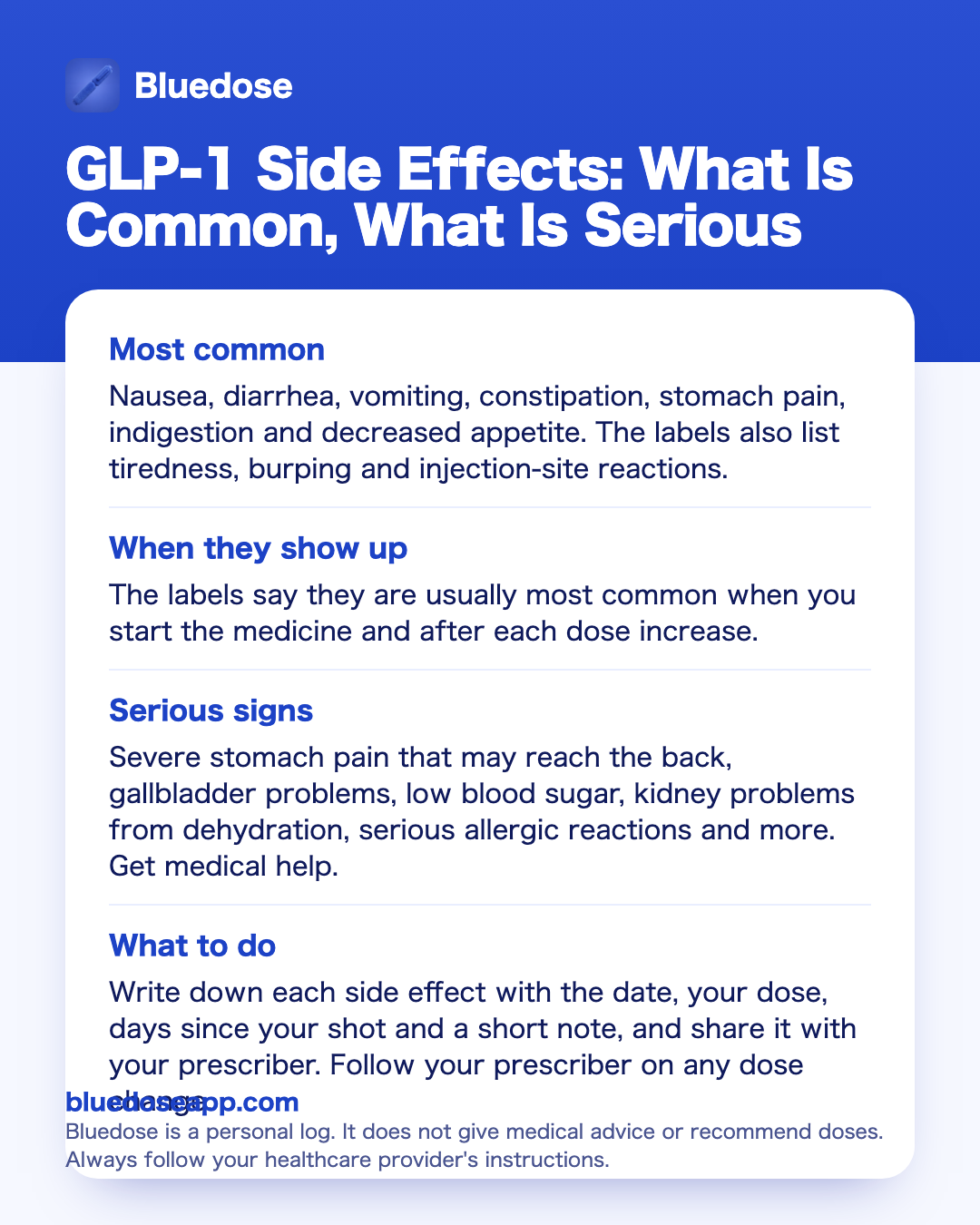
- Most commonNausea, diarrhea, vomiting, constipation, stomach pain, indigestion and decreased appetite. The labels also list tiredness, burping and injection-site reactions.
- When they show upThe labels say they are usually most common when you start the medicine and after each dose increase.
- Serious signsSevere stomach pain that may reach the back, gallbladder problems, low blood sugar, kidney problems from dehydration, serious allergic reactions and more. Get medical help.
- What to doWrite down each side effect with the date, your dose, days since your shot and a short note, and share it with your prescriber. Follow your prescriber on any dose change.

Best overall: Bluedose
Bluedose logs each shot with its dose and injection site, then lets you add side effect check-ins with notes, so you will see whether nausea follows a dose increase or a certain day after your shot. Everything stays on your iPhone and in your own private iCloud, with no account and no ads. It is a personal log; it does not judge whether a side effect is serious or give medical advice.
Free on the App StoreCommon side effects of GLP-1 medicines
The prescribing information for Ozempic, Wegovy, Mounjaro and Zepbound lists a similar set of common side effects. Ozempic and Wegovy contain semaglutide. Mounjaro and Zepbound contain tirzepatide. Most of the common side effects involve the stomach and digestion.
The labels list these as the most common:
- Nausea
- Diarrhea
- Vomiting
- Constipation
- Stomach (abdominal) pain
- Indigestion
- Decreased appetite
The labels also list tiredness, burping and injection-site reactions at the spot where you injected.
Common means these show up often enough to sit near the top of the label. It does not mean you will get all of them, or any of them. Your own list will be shorter or longer than someone else's on the same dose.
Each medicine has its own label with its own wording. For detail on one drug, read the pages on ozempic side effects, mounjaro side effects and wegovy side effects. Zepbound contains the same medicine as Mounjaro, so the Mounjaro page is a good starting point, and your Zepbound leaflet has the exact wording.
When people search for the side effects of GLP-1 medicines, this short list is what they find first. The more useful questions are when these side effects show up, and which ones need a call to your prescriber. The next sections cover both.
When side effects show up: starting and dose increases
The labels say the common side effects are usually most common at two moments: when you start the medicine, and after a dose increase. That matters because every GLP-1 label uses a step-up schedule.
Here is what the prescribing information describes:
- Ozempic: 0.25 mg once weekly for 4 weeks as a starting dose, then 0.5 mg. The dose may go up to 1 mg after at least 4 weeks, then to 2 mg after at least 4 more weeks. The maximum is 2 mg.
- Wegovy: 0.25 mg in weeks 1 to 4, 0.5 mg in weeks 5 to 8, 1 mg in weeks 9 to 12, 1.7 mg in weeks 13 to 16, and 2.4 mg once weekly from week 17. The label allows 1.7 mg as a maintenance dose if 2.4 mg isn't tolerated. A higher 7.2 mg option exists in some countries; ask your prescriber.
- Mounjaro and Zepbound: 2.5 mg once weekly for 4 weeks, then steps of 2.5 mg after at least 4 weeks on the current dose (5, 7.5, 10, 12.5 mg), up to a maximum of 15 mg once weekly. The 2.5 mg dose is a starting dose, not a maintenance dose.
So the first months include several step-ups, and each one is a point where the labels say side effects are more likely. If you log the dose with every shot, you will see whether a rough week lines up with a new dose or with something else in your week.
Your prescriber decides when, and whether, you move to the next dose. Do not change the schedule on your own because of side effects. Tell your prescriber what you are noticing and follow their plan. If a step-up is coming, the guide on mounjaro dose increase walks through that week, and first week on mounjaro covers the very start.
Serious side effects: when to get medical help
The labels also list serious side effects. These are the ones to know by name. If you think you have one of them, get medical help.
- Possible thyroid C-cell tumors. This is a boxed warning. The labels say not to use these medicines if you or a family member has had medullary thyroid cancer, or if you have MEN 2.
- Pancreatitis. The sign the labels describe is severe stomach pain that may reach your back.
- Gallbladder problems.
- Low blood sugar, especially when the medicine is used with insulin or a sulfonylurea.
- Kidney problems from dehydration. Losing fluids through vomiting or diarrhea is the link the labels make.
- Serious allergic reactions.
- Diabetic eye problems, listed for semaglutide (Ozempic, Wegovy).
- Stomach emptying problems.
A log is not a triage tool. If something feels severe or wrong, call your prescriber, or emergency services if it is urgent, before you open any app. You can write it down afterwards, and that note will still help at the follow-up visit.
Your pen's leaflet has the full list and the exact symptoms to watch for. Keep it somewhere you can find it, or ask your pharmacist for a new copy.
Who should pay closer attention to certain side effects
Some side effects matter more for some people. The labels point to a few groups:
- People with a personal or family history of medullary thyroid cancer, or with MEN 2. The boxed warning says not to use these medicines.
- People who also take insulin or a sulfonylurea. The labels flag low blood sugar especially in this group. Tell your prescriber about every medicine you take.
- People with diabetes on semaglutide. The labels list diabetic eye problems.
- Anyone with ongoing vomiting or diarrhea. The labels link dehydration to kidney problems.
- Anyone in the first weeks or right after a dose increase. The common side effects are usually most common then.
None of this means you will have a problem. It means these are the places where a clear log and an honest talk with your prescriber help most. If you belong to one of these groups, bring it up at the start, not after the first difficult week.
How to log GLP-1 side effects with notes
A weekly shot makes side effects hard to remember. Nausea on day two, a quiet day four, constipation over the weekend: by the next appointment it blurs into "the first month was rough". A short log fixes that.
For each side effect, note:
- What it was, in plain words (nausea, burping, tiredness).
- When it started, and how many days after your shot.
- Your current dose, exactly as your prescriber gave it.
- How it affected your day, in your own words.
- Anything around it: what you ate, how much you drank, how you slept.
- The injection site, if the reaction is at the spot where you injected.
Short notes work best. "Nausea after lunch, gone by evening" is enough. The value comes from doing it every time, so a pattern shows up across weeks.
Injection-site reactions are easier to read when you know which site you used. The labels say to rotate the injection site with each dose, and you can use the same body area but a different spot. The guide on injection site rotation covers the stomach area, the front of the thigh and the back of the upper arm.
If you want a dedicated tool, a side effect tracker keeps these notes next to each shot. Before an appointment, a side effects log for your doctor turns weeks of notes into a short summary you can read out.
Appetite, food noise and eating less
Decreased appetite is on the labels' list of common side effects. Many users also describe a change they call food noise: constant thoughts about food that quiet down on a GLP-1. Food noise is a user term, not a label term. It is still worth logging next to your side effects, because it gives context to appetite changes. Read more about food noise.
When appetite drops, it is easy to lose track of what you ate. Some people track protein so their low-appetite days are visible in their log. The page on protein on GLP-1 explains why people do this.
Ask your prescriber or a dietitian what you should eat. A log shows what happened; it does not set a target for you. Together, appetite notes, food noise check-ins and your side effect notes give your prescriber a clearer picture than memory alone.
GLP-1 side effects at a glance: common vs serious
A quick matrix of the side effects named in the prescribing information, split into common and serious, with what is useful to write down. Check your own leaflet for the full list.
| Side effect | Type | What the labels say | Useful to note in your log |
|---|---|---|---|
| Nausea | Common | Usually most common when starting or after a dose increase | Time, days since your shot, current dose |
| Diarrhea | Common | Listed among the most common | How often, how much you drank |
| Vomiting | Common | Listed among the most common; losing fluids links to dehydration | How often, fluids kept down |
| Constipation | Common | Listed among the most common | Days it lasted, short note |
| Stomach pain, indigestion | Common | Listed among the most common | When it started, what you ate |
| Decreased appetite | Common | Listed among the most common | Food noise check-in, protein |
| Tiredness, burping | Common | Also listed on the labels | Short note with the day |
| Injection-site reactions | Common | Labels say to rotate the site with each dose | Site on the body map |
| Possible thyroid C-cell tumors | Serious (boxed warning) | Don't use with a personal or family history of medullary thyroid cancer or MEN 2 | Tell your prescriber your history |
| Pancreatitis | Serious | Severe stomach pain that may reach the back; get medical help | Get help first, log later |
| Gallbladder problems | Serious | Get medical help | Get help first, log later |
| Low blood sugar | Serious | Especially with insulin or sulfonylureas | Other medicines you take |
| Kidney problems | Serious | Linked to dehydration | Vomiting or diarrhea before it |
| Serious allergic reaction | Serious | Get medical help | Get help first, log later |
| Diabetic eye problems | Serious | Listed for semaglutide | Tell your prescriber |
| Stomach emptying problems | Serious | Get medical help | Get help first, log later |
When a notes app or paper log is enough
For many people that is enough. If you are on a steady dose, side effects are mild, and you only want something to show at your next visit, a phone note works. Write the date, the dose, the side effect and one line about it. A paper log on the fridge does the same, and a calendar entry on shot day reminds you to check in with yourself.
These options are free, private and already on your phone. The limits show up over time. A notes app does not connect a side effect to the shot that came before it. It does not remember your injection site. Scrolling back three months to find when nausea started gets slow, and a paper log stays at home when you are at the clinic.
When you need more than notes
- You are starting a GLP-1 or about to step up a dose, and want to see side effects against each shot and dose.
- You get injection-site reactions and want to know which spots they followed.
- You want food noise, protein and weight in the same place as your side effect notes.
- You want a shot-day reminder so check-ins happen while side effects are fresh.
- You want answers from your own history, not from memory, before an appointment.
How to start tracking side effects with Bluedose
Install Bluedose
Bluedose: GLP-1 Tracker runs on iPhone with iOS 18 or later. Start for free. There is no account to create.
Set your medicine and schedule
Pick Zepbound, Mounjaro, Wegovy, Ozempic, or compounded semaglutide or tirzepatide, and set a weekly, twice weekly, daily or custom schedule. Choose your reminder time; on shot day a Lock Screen card with a Log Shot button appears.
Log each shot
Tap to log the drug, the dose your prescriber gave you and the time. Tap the body map to record the site; Bluedose remembers the rotation and suggests the next site.
Add side effect check-ins
When something comes up, add a check-in for side effects or food noise and write a short note in your own words.
Review before your appointment
Open your shot history and trends to see the pattern. On supported devices, use Ask to question your own logs, for example "Is my food noise changing?"
FAQ
What are the most common side effects of GLP-1 medicines?
The prescribing information for Ozempic, Wegovy, Mounjaro and Zepbound lists nausea, diarrhea, vomiting, constipation, stomach (abdominal) pain, indigestion and decreased appetite as the most common. The labels also list tiredness, burping and injection-site reactions.
When are GLP-1 side effects most likely to happen?
The labels say the common side effects are usually most common when you start the medicine and after a dose increase. Every GLP-1 label uses a step-up schedule, so the first months include several of these moments. Logging your dose with each shot shows whether a rough week lines up with a step-up.
Which GLP-1 side effects are serious?
The labels list possible thyroid C-cell tumors (a boxed warning), pancreatitis (severe stomach pain that may reach the back), gallbladder problems, low blood sugar (especially with insulin or sulfonylureas), kidney problems from dehydration, serious allergic reactions, diabetic eye problems (semaglutide) and stomach emptying problems. If you think you have one of these, get medical help.
Do Ozempic and Mounjaro have the same side effects?
Their common side effects look very similar on the labels: mostly nausea, diarrhea, vomiting, constipation and other stomach complaints. Ozempic contains semaglutide and Mounjaro contains tirzepatide, and each label has its own wording. Diabetic eye problems are listed for semaglutide. Read the leaflet for your own pen for the exact list.
Should I skip a dose because of side effects?
Do not decide that on your own. Tell your prescriber what you are noticing and follow their plan. The labels do have rules for a missed dose, but that covers a forgotten shot, not a choice to stop because of side effects.
Is food noise a side effect?
No. Food noise is a user term for constant thoughts about food, and many users report it quiets on GLP-1 medicines. It is not a label term. Decreased appetite is the related item the labels list among the common side effects.
Does Bluedose tell me if a side effect is serious?
No. Bluedose is a personal log. It records your shots, doses, injection sites and side effect check-ins with notes, but it does not give medical advice or judge symptoms. For anything that feels severe, contact your prescriber or emergency services.
Bottom line
GLP-1 side effects are mostly digestive, and the labels say they are usually most common when you start or after a dose increase. A short list of serious ones, from pancreatitis to low blood sugar, needs medical help, not a log entry. Know that list, keep your leaflet, and follow your prescriber on every dose decision.
For tracking, a phone note is a fair start, and for many people it is enough. If you want side effects tied to each shot, dose and injection site, with food noise and protein alongside, Bluedose keeps it all private on your iPhone. This is general information, not medical advice.
Sources
- Ozempic prescribing information
- Wegovy prescribing information
- Mounjaro prescribing information
- Zepbound prescribing information
- Mayo Clinic, semaglutide proper use
Save this guide
Keep the key points as an image on your phone.
Log side effects next to every shot
Keep your shots, side effects and notes together in one private log on your iPhone, free on the App Store.
Free on the App Store