Bluedose

Quick answer
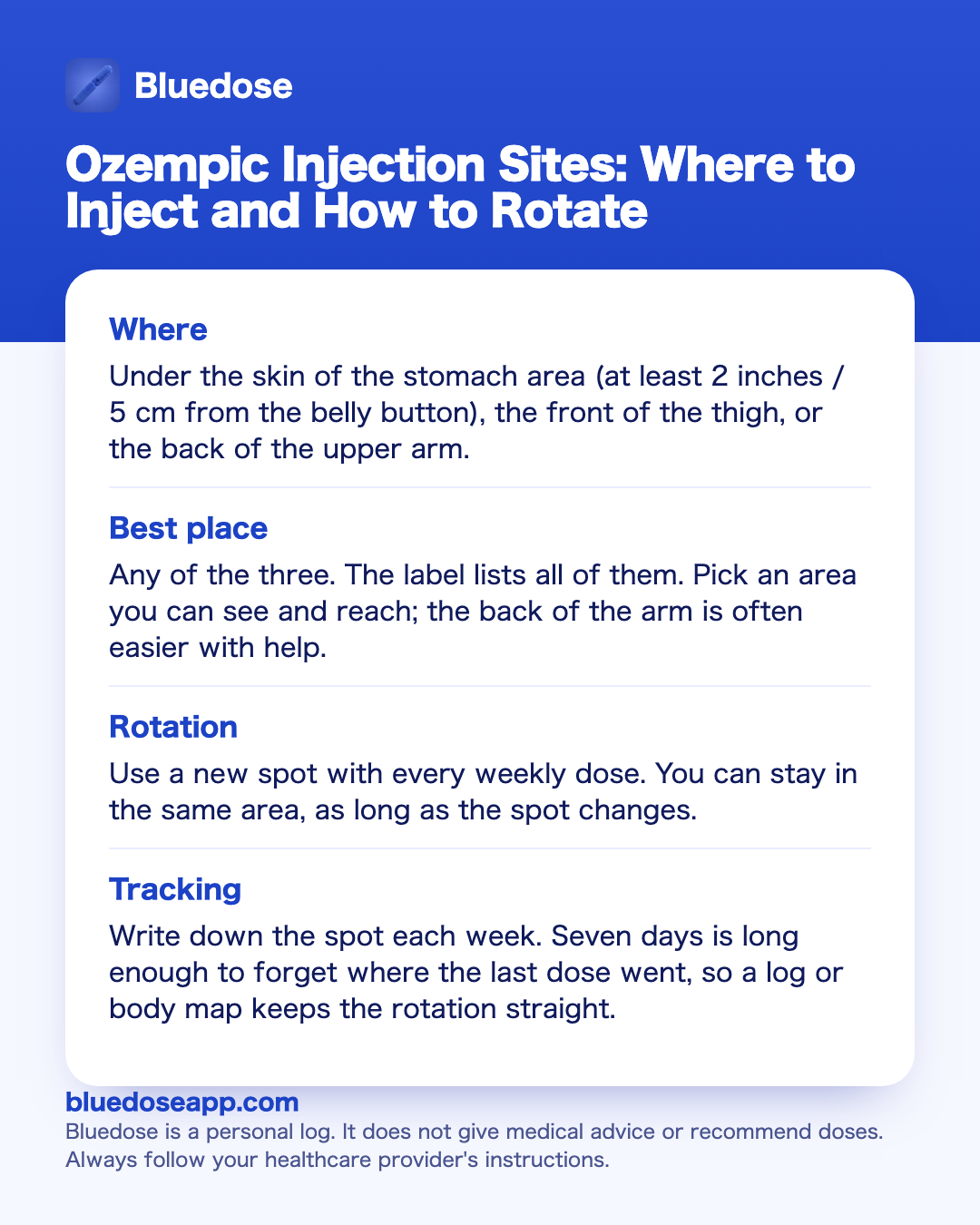
- WhereUnder the skin of the stomach area (at least 2 inches / 5 cm from the belly button), the front of the thigh, or the back of the upper arm.
- Best placeAny of the three. The label lists all of them. Pick an area you can see and reach; the back of the arm is often easier with help.
- RotationUse a new spot with every weekly dose. You can stay in the same area, as long as the spot changes.
- TrackingWrite down the spot each week. Seven days is long enough to forget where the last dose went, so a log or body map keeps the rotation straight.
Best overall: Bluedose
Bluedose turns this page into a weekly habit. After each Ozempic shot you tap the spot on a body map, and Bluedose remembers the rotation and suggests the next site, so you never guess where last week's dose went. It is a private personal log on your iPhone with no account, and it does not give medical advice or recommend doses.
Free on the App StoreWhere to inject Ozempic: the three areas on the label
The Ozempic prescribing information names three areas for the injection. In each one, the medicine goes under the skin.
- Stomach area (abdomen). Use the skin of the belly and stay at least 2 inches (5 cm) away from the belly button. There is room on both the left and the right side.
- Front of the thigh. Use the front of either thigh. When you sit down, it is right in front of you.
- Back of the upper arm. Use the back of either upper arm. This spot is hard to see on your own, so many people use it with help from a partner, friend or family member.
That is the full list. If you have heard of other places, check with your pharmacist before you try them, and stick to what the label and your prescriber say.
These three areas are not unique to Ozempic. Wegovy, Mounjaro and Zepbound use the same ones. If your prescriber ever moves you to a different pen, the map on your body stays the same. Our guide to Mounjaro injection sites covers the tirzepatide pens in the same way.
For the injection steps themselves, such as how to hold the pen and how long to keep it in place, follow the instructions for use that come in your Ozempic carton. If anything is unclear, your pharmacist will walk you through it. This page covers the where and the rotation. The leaflet covers the how.
What is the best place to inject Ozempic?
People search for the best place to inject Ozempic hoping for one clear winner. The label does not give one. It lists the stomach area, the front of the thigh and the back of the upper arm as options, and you make the choice with your prescriber.
In practice, the best place is the one you will use well every week. A few plain questions help you choose:
- Can you see it? When you can see the skin, it is easier to place the pen where you mean to and to keep the 2-inch (5 cm) gap from the belly button.
- Can you reach it without strain? The stomach area and the front of the thigh are close at hand. The back of the upper arm often needs a second pair of hands.
- Is it comfortable for you? Comfort is personal. Some people prefer one area. Others like to switch between them. Both approaches fit the label, as long as the spot changes each week.
- Does it leave room to rotate? An area with more skin to work with makes it simpler to pick a fresh spot every time.
If you have a scar, a skin condition, or a question about one area over another, ask your prescriber or pharmacist. They know your history. A general guide does not.
How to rotate Ozempic injection sites
Rotation is the second half of the instruction. The label says to rotate the injection site with each dose. Ozempic is a once-weekly shot, so that means a new spot every week.
Rotation does not force you to change body area. You can use the stomach area week after week, as long as you pick a different spot each time. You can also move between areas. Either way, the rule is simple: do not land on last week's spot.
A pattern makes this easier. Here is one example that stays inside the label. It is a memory aid, not a medical instruction:
- Week 1: left side of the stomach area
- Week 2: right side of the stomach area
- Week 3: front of the left thigh
- Week 4: front of the right thigh
- Week 5: back to the stomach area, at a new spot
If you use the back of the arm with help, add the left and right arm to the cycle on the weeks someone is around. Some people only use one area and move around it in a small circle. That works too, as long as you know where the last dose went.
That last part is the hard part. Our guide to injection site rotation goes deeper into patterns and how to keep track of them over months.
Why a weekly shot makes sites easy to forget
A daily habit sticks because you repeat it every day. A weekly shot does not get that help. Seven days pass between doses, and in that time most people lose the detail of where the last one went.
When shot day comes, you have two choices: guess, or check a record. Only the record is reliable. That is why many people keep a small log, a note on their phone, or an Ozempic app that stores the site with each shot.
The same goes for the day itself. A weekly dose is easy to miss when the week gets busy. A GLP-1 shot reminder at the time you choose takes that load off your memory, and the site log takes care of the rest.
A good record answers four questions at a glance:
- When was my last shot?
- What dose did my prescriber give me, and did I take it?
- Where did it go?
- Did I notice anything afterward?
If your log answers those four, it is doing its job, whatever form it takes. Paper, a notes app and a dedicated tracker all work. The difference is how much effort each one takes to keep up, and how quickly you can find last week's answer when the pen is already in your hand.
Injection-site reactions and side effects worth writing down
Injection-site reactions are on the label's list of common side effects. The most common side effects overall are stomach related: nausea, diarrhea, vomiting, constipation, stomach (abdominal) pain, indigestion and decreased appetite. Tiredness and burping are also listed. These are usually most common when starting or after a dose increase.
When you notice something at a site, note the spot, the date and what you saw. Over a few weeks the log will show whether it happens in one area more than another. That is useful to share with your prescriber or pharmacist. The full list is in our guide to Ozempic side effects.
Some effects need medical help. The label lists serious problems, including:
- serious allergic reactions
- pancreatitis (severe stomach pain that may reach the back)
- gallbladder problems
- low blood sugar, especially with insulin or sulfonylureas
- kidney problems from dehydration
- diabetic eye problems
- stomach emptying problems
- possible thyroid C-cell tumors (a boxed warning; the label says not to use it with a personal or family history of medullary thyroid cancer or MEN 2)
If you think you have one of these, contact your prescriber or seek medical help. A log is a record, not a replacement for care.
A side effect tracker keeps those notes in one place. Before an appointment, our guide to keeping a side effects log for your doctor shows how to bring weeks of notes into a short, clear summary.
Other Ozempic facts to keep next to your site log
The site is one line in your weekly record. A few label facts sit next to it.
Dose schedule. The Ozempic label starts at 0.25 mg once weekly for 4 weeks. That is a starting dose. Then it moves to 0.5 mg. It may increase to 1 mg after at least 4 weeks, and then to 2 mg after at least 4 more weeks. 2 mg is the maximum. Your dose and timing come from your prescriber, not from a chart. The Ozempic dosage chart lays out the label schedule.
Missed doses. The label says to take a missed dose as soon as possible within 5 days of the missed dose. If more than 5 days have passed, it says to skip it and take the next dose on the regular day. Follow your prescriber, and see our guide to a missed dose of Ozempic for the full rule.
Storage. Before first use, keep the pen in the refrigerator at 2-8 °C (36-46 °F), in the carton, away from light. Do not freeze it, and do not use a pen that has frozen. After first use, the pen can stay in the fridge or at room temperature up to 30 °C (86 °F) for 56 days. More detail is in how to store Ozempic.
How long it lasts. Semaglutide has an elimination half-life of about 1 week, and it takes about 5 weeks to clear. Ask your prescriber what that means for you.
This is general information, not medical advice.
Ozempic injection sites at a glance
The three areas from the label, with practical notes for rotating within each one.
| Area | Where on the body | Reaching it | Rotating within it |
|---|---|---|---|
| Stomach area (abdomen) | Under the skin of the belly, at least 2 inches (5 cm) from the belly button | Easy to see while you inject | Switch between left and right sides and pick a new spot each week |
| Front of the thigh | Under the skin on the front of either thigh | Close at hand when sitting | Alternate left and right thigh and move to a fresh spot each time |
| Back of the upper arm | Under the skin on the back of either upper arm | Hard to see; often done with help | Use it on weeks someone can help; change arm and spot each time |
| Any area | Follow the instructions for use in your carton | Ask your pharmacist if unsure | Never reuse last week's spot; log where each dose went |
When a paper log or phone note is enough
For many people that is enough. If you take one Ozempic shot a week and use one or two areas, a simple record will hold the rotation.
- Paper log. A card with the date and the site, kept where you keep your supplies.
- Phone notes. One line per week, such as the date and left stomach.
- Calendar. A weekly event on shot day with the site in the title, and an alert built in.
These tools are free, private and already on hand. They work well when your routine is steady, you track little beyond the shot, and you check the note every time.
Their limit shows up when you skip a week of writing, when you want to see a pattern across months, or when you track side effects, weight or protein next to the shot. Then the notes spread across paper and apps, and the rotation gets harder to see at a glance.
When you need more than notes
- You keep forgetting which side or spot you used last week and want the next site suggested for you.
- You want a reminder on shot day and a one-tap way to log the dose from the Lock Screen.
- You track side effects, food noise, protein or weight and want them next to your shot history.
- You want a clear history of every shot to bring to your next appointment.
- You want all of it private, with no account, no ads and no tracking.
How to start tracking Ozempic injection sites with Bluedose
Install Bluedose
Bluedose: GLP-1 Tracker is free on the App Store for iPhone (iOS 18 or later). There is no account to create.
Set your Ozempic schedule
Choose Ozempic and a weekly schedule, then set your reminder time. On shot day, a Lock Screen card with a Log Shot button appears.
Log the shot and tap the site
Enter the dose your prescriber gave you, then tap the spot on the body map. Bluedose saves the site with the time.
Follow the suggested next site
Next week, Bluedose remembers the rotation and suggests the next site. You stay in charge and pick a spot that fits the label and your prescriber's advice.
Add check-ins when you notice something
Log side effects and food noise with notes, and see weight, protein and food noise over time in Trends.
FAQ
Where do you inject Ozempic?
Under the skin in one of three areas: the stomach area (at least 2 inches / 5 cm from the belly button), the front of the thigh, or the back of the upper arm. Follow the instructions for use in your Ozempic carton for the injection steps.
What is the best place to inject Ozempic?
The label lists all three areas as options and does not name one winner. The best place for you is an area you can see, reach and rotate around. If you have a scar, a skin condition or another concern, ask your prescriber or pharmacist.
Can I inject Ozempic in the same spot every week?
No. The label says to rotate the injection site with each dose. You can stay in the same body area, such as the stomach, but use a different spot each week.
How far from the belly button should I inject Ozempic?
The label says to stay at least 2 inches (5 cm) away from the belly button when you use the stomach area.
Can I inject Ozempic in my arm by myself?
The back of the upper arm is one of the three listed areas. It is hard to see and reach on your own, so many people use it with help from someone else. Your pharmacist will show you the technique if you ask.
Are Ozempic injection sites the same as Mounjaro and Wegovy?
Yes. Wegovy, Mounjaro and Zepbound use the same three areas: the stomach area, the front of the thigh and the back of the upper arm. The rotation rule is the same too.
Does Bluedose tell me where to inject?
Bluedose records the spot you tap on a body map, remembers your rotation and suggests the next site. It is a personal log. It does not give medical advice and does not recommend or calculate doses.
Bottom line
Ozempic goes under the skin of the stomach area, the front of the thigh or the back of the upper arm, and the spot changes with every weekly dose. No single area is best for everyone. The right one is the area you can reach, use comfortably and rotate around. Follow the instructions in your carton and your prescriber.
If a note on your phone keeps your rotation straight, keep using it. If you want the site logged in a tap, the next spot suggested, and your shots, side effects and trends in one private place on your iPhone, Bluedose will do that.
Sources
- Ozempic prescribing information
- Mayo Clinic, semaglutide proper use
- Wegovy prescribing information
- Mounjaro prescribing information
Save this guide
Keep the key points as an image on your phone.
Log every Ozempic site in one tap
Start for free and let Bluedose remember your rotation and suggest the next site.
Free on the App Store